
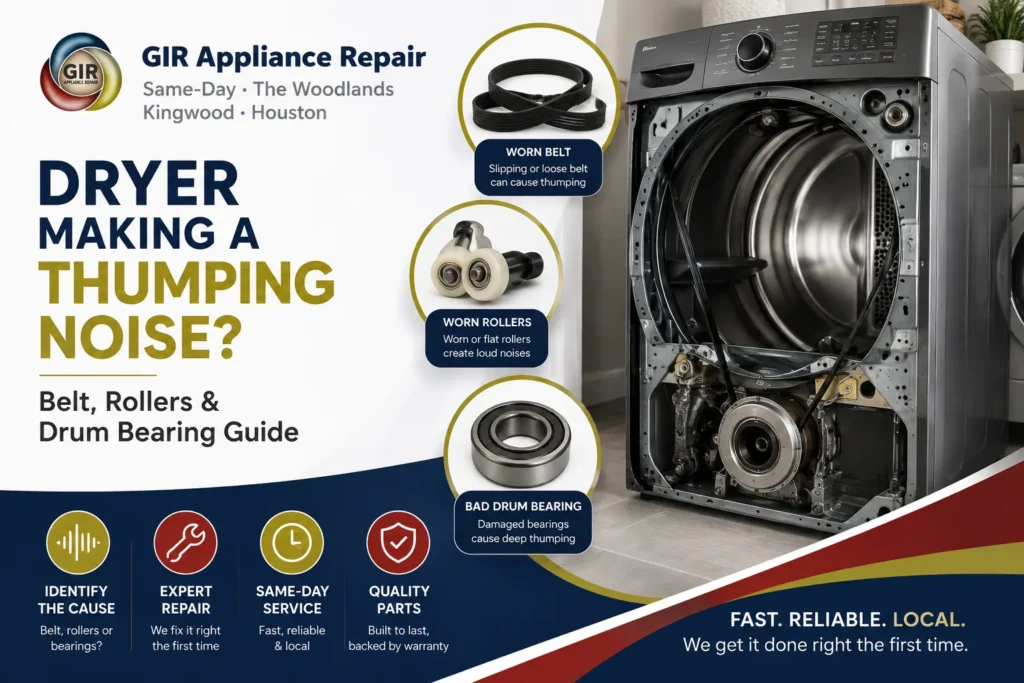
A dryer that suddenly starts thumping, thudding, or sounding like there’s a shoe tumbling around inside — even when the load is just towels or sheets — is one of the most common noise complaints GIR Appliance Repair hears across Houston, The Woodlands, Kingwood, Spring, and Conroe. The good news is that loud, rhythmic dryer noise almost always traces back to one of three parts: the drive belt, the drum support rollers, or the drum’s rear bearing. This guide walks through how to tell them apart by sound and symptom, and what repair typically costs for each.
Dryer Noise Symptoms & Likely Causes
| Sound | Likely Cause | Est. Repair Cost |
|---|---|---|
| Heavy, rhythmic thumping in time with drum rotation | Worn or flattened drum support roller(s) | $120–$260 |
| Loud squeal or squeak that changes with drum speed | Dry or worn drum support rollers, or a worn idler pulley | $110–$240 |
| Drum won’t turn, or motor hums without tumbling | Snapped drive belt | $110–$230 |
| Deep grinding or scraping noise, especially heavy loads | Worn rear drum bearing or glide bearing | $150–$320 |
| Metal-on-metal scraping that’s constant, not rhythmic | Drum no longer riding evenly on rollers or bearing, contacting the cabinet | $160–$340 |
Drum Support Rollers: The Most Common Culprit
Most dryer drums rest on two or more small wheel-shaped rollers near the back (and sometimes front) of the cabinet, which let the heavy drum spin smoothly on its track. Over years of use, these rollers develop flat spots or their axles wear out, and the drum starts thumping once per rotation as it rolls over the flat spot — a distinctly rhythmic sound that speeds up and slows down with the drum. This is by far the single most common source of dryer thumping noise GIR technicians diagnose, and it’s a relatively inexpensive, quick repair since the rollers are accessible once the front or rear panel is removed.
Drive Belt Problems: Silence or a Slapping Sound
The drive belt wraps around the drum and connects to the motor via a pulley system, and it’s what actually spins the drum during a cycle. A belt that’s about to fail often makes a rhythmic slapping or flapping noise for days or weeks before it finally snaps. Once it does snap, the symptom changes completely: the dryer motor runs (you’ll hear a hum) but the drum doesn’t turn at all, and clothes just sit in a pile getting blown with warm air instead of tumbling. If your dryer went from noisy to completely silent-drum overnight, a snapped belt is almost always the reason.
Rear Drum Bearing: The Most Expensive of the Three
Behind the drum, a bearing (sometimes a ball bearing, sometimes a felt or plastic glide bearing depending on the brand) supports the rear of the drum shaft and lets it spin freely. When this wears out, it produces a deeper, more constant grinding or scraping sound than the rhythmic thump of a bad roller, and it tends to get noticeably worse under heavier loads since more weight is pressing on the worn bearing surface. Bearing replacement is typically the most labor-intensive of the three repairs, since it usually requires more disassembly to access, which is reflected in the higher end of the repair cost range.
Why These Three Parts Often Fail Together
Because the rollers, belt, and bearing are all part of the same drum-support system, a problem with one often accelerates wear on the others. A drum that’s not sitting evenly because of a worn roller puts uneven tension on the belt, and a struggling belt puts extra load on the bearing. This is why GIR technicians inspect all three components during a noise-related service call rather than just replacing the one part that seems most obviously worn — replacing only the roller on a dryer that also has a badly worn bearing often means a second service call within a few months for the part that was overlooked.
DIY vs. Calling a Professional
Diagnosing dryer noise by sound alone gets homeowners most of the way there, but confirming the exact part (and whether more than one needs replacing) usually requires removing the front or rear panel and physically inspecting the rollers, belt routing, and bearing — not a difficult job for someone comfortable with basic tools, but one where reassembling the belt incorrectly around the motor pulley and idler is a common DIY mistake that leaves the dryer worse off than before. Given the risk of a partial fix missing a second failing part, most homeowners find it faster and more reliable to have a technician diagnose and repair all of it in one visit.
Front vs. Rear Rollers & Idler Pulleys
Depending on the brand and model, a dryer may have support rollers at the rear only, or at both the front and rear of the drum. Front rollers tend to wear differently than rear ones since they carry the drum’s weight where it exits toward the door, and a thump that seems to come from near the front of the machine versus deep inside the cabinet can help a technician narrow down which roller set is worn before even opening the panel. The idler pulley, a separate spring-loaded wheel that keeps tension on the drive belt, is another common noise source that’s easy to overlook — a worn idler pulley bearing produces a squeal very similar to a worn roller, and the two are often replaced together during a single repair visit since they’re both accessible at the same time.
What Happens If a Worn Roller Is Left Too Long
A flat-spotted roller doesn’t just make noise — over time it can wear unevenly enough that the drum starts sitting slightly off-center in the cabinet, which increases the chance of the drum eventually rubbing directly against the cabinet frame or heating element housing. That’s the point where a relatively inexpensive $120–$260 roller repair can turn into a more expensive repair involving drum or housing damage, plus the increased fire risk of the drum contacting an internal heat source. Addressing rhythmic thumping within the first few weeks of noticing it, rather than waiting months, is the difference between a routine roller swap and a more involved repair.
How Technicians Confirm the Exact Part Before Ordering
Because roller, belt, and bearing symptoms can sound similar to an untrained ear — especially once a dryer has more than one worn component at once — GIR technicians remove the front or rear panel and manually spin the drum by hand with the dryer unplugged. A drum that spins freely and quietly by hand but was noisy when running points toward the belt or motor pulley system; a drum that feels rough, gritty, or resistant when turned by hand points more directly to the rollers or rear bearing. This hands-on check, done before any parts are ordered, is what keeps repair visits to a single trip rather than guessing and needing a follow-up appointment.
Gas vs. Electric Dryers: Same Mechanical Parts
The drum support system — rollers, belt, and rear bearing — is essentially identical between gas and electric dryers, since both use the same basic drum-and-motor mechanical design regardless of what heats the air. This means the diagnosis process and repair costs covered in this guide apply equally whether you have a gas or electric model; the only real difference in a service visit is that a gas dryer technician will also confirm the gas supply valve is fully shut off before opening the cabinet, as a standard safety step.
🔧 Need a professional repair?
GIR Appliance Repair serves Houston, The Woodlands & Kingwood — same-day availability.
How Long Do Rollers, Belts, and Bearings Typically Last?
Most manufacturers design these components to last 8–12 years under normal household use, though usage intensity matters more than calendar age — a household running multiple loads daily will see wear years earlier than one running a load every few days. If your dryer is within that age range and starts making rhythmic noise, it’s a reasonably predictable wear-and-tear repair rather than a sign of a manufacturing defect or misuse, and replacement parts remain widely available even on older models from major brands.
Frequently Asked Questions
Why does my dryer sound like it has shoes in it?
That rhythmic thumping sound, even without shoes in the load, is the classic symptom of a worn or flat-spotted drum support roller. It’s one of the most common and least expensive dryer repairs.
My dryer runs but the drum won’t spin. What’s wrong?
This is almost always a snapped drive belt. The motor still runs (you’ll hear it humming), but with no belt connecting it to the drum, nothing tumbles.
How do I know if it’s a roller or a bearing?
Roller noise is a rhythmic thump that times with each drum rotation. Bearing noise is a deeper, more constant grinding sound that tends to get louder with heavier loads.
How much does it cost to fix a noisy dryer?
Most roller and belt repairs run $110–$260. Bearing replacement, being more labor-intensive, typically runs $150–$340. GIR always diagnoses first and gives an upfront quote before repair.
Can I keep using a noisy dryer?
You can for a short time, but a failing roller or bearing tends to get worse and can eventually cause the drum to sit unevenly and rub against the cabinet, turning an inexpensive repair into a more expensive one. It’s worth addressing promptly.
Dryer thumping, squealing, or grinding? Contact GIR online or call (346) 625-4289 for same-day diagnosis across Houston, The Woodlands, Kingwood, Spring, and Conroe.
Ready to schedule your repair?
We serve The Woodlands, Kingwood, Spring, Humble & greater Houston. Call or book online.