
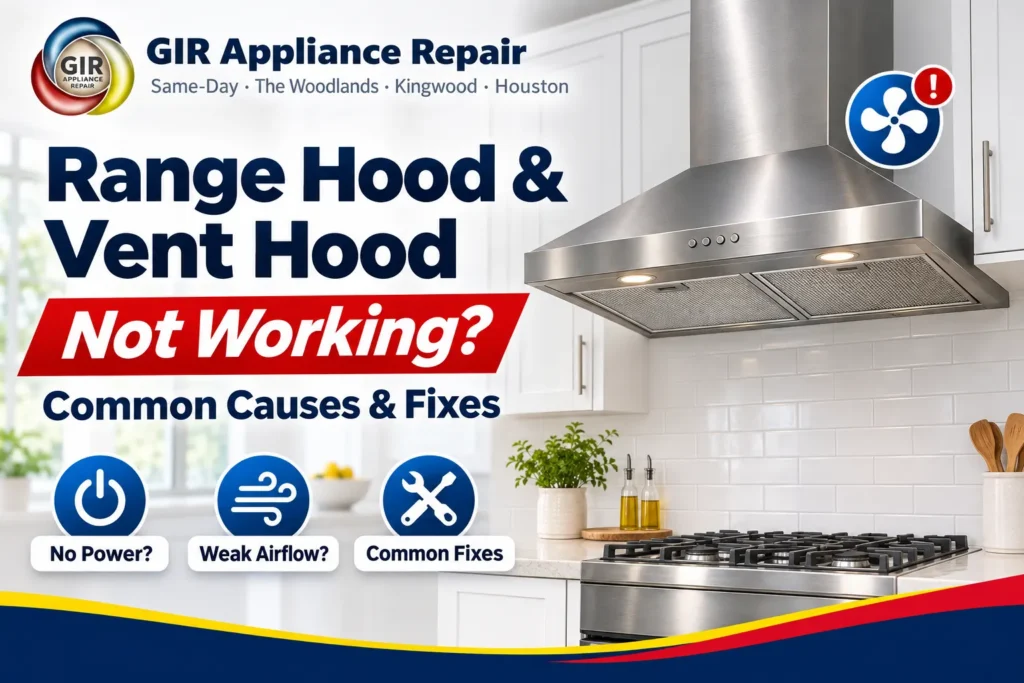
A range hood that stops pulling smoke, steam, and grease out of the kitchen is more than an annoyance — it leaves cooking odors soaked into cabinets, fogs up windows, and lets grease settle on surfaces throughout the kitchen. Whether your hood has gone completely silent, the fan runs but barely moves air, or the light works while the fan doesn’t (or vice versa), the cause usually traces back to one of a handful of parts. This guide walks through what typically fails, what you can safely check yourself, and what repair costs look like for ducted and ductless range hoods alike.
Range Hood Not Working: Common Causes & Fixes
| What you notice | Most likely cause | Typical Repair Cost |
|---|---|---|
| Fan won’t run, light still works | Failed fan motor or a bad fan switch | $120–$280 |
| Nothing works at all — fan and light dead | Tripped breaker, failed control board, or a wiring fault | $0 (reset) to $180–$380 |
| Fan runs but barely pulls any air | Blocked or crushed ductwork, or a grease-caked fan wheel | $130–$300 |
| Weak airflow on a ductless (recirculating) hood | Saturated charcoal filter that needs replacing | $30–$80 (filter) to $150 (if motor is also affected) |
| Light works, fan doesn’t (or fan works, light doesn’t) | Failed switch for that specific function, or a broken connection | $90–$220 |
| Loud grinding, rattling, or buzzing from the fan | Worn fan motor bearings or a bent/unbalanced fan wheel | $130–$300 |
Prices are typical ranges for parts and labor in the Houston area. Your exact cost depends on the hood’s brand, whether it’s a standard under-cabinet unit, an insert, or an over-the-range microwave/hood combo, and what our technician finds. Our $75 service call covers the diagnostic visit and is applied toward the repair if you move forward.
Why a Range Hood Stops Working
Fan Motor Failure
The fan motor is the part under the most daily stress, and it’s the single most common reason a range hood fan goes quiet or weak. Years of grease-laden air passing through the motor housing lets residue build up on the windings and bearings, which makes the motor work harder until it eventually seizes or burns out. A motor that’s failing often gives warning signs first — a louder hum, slower startup, or the fan running at only one speed regardless of the switch setting.
Light or Fan Switch and Control Board Problems
Most range hoods use simple rocker or slide switches for the fan speed and light, and these wear out or corrode from heat and grease exposure over time. On newer hoods with electronic touch controls or a built-in control board, a failed board can take out the fan, the light, or both at once, and sometimes causes odd behavior like a fan that only runs on high or a light that flickers. If the fan and light fail independently of each other, the switch for that specific function is usually the culprit; if everything dies at once, look at the control board or the power supply first.
Wiring and Power Supply Issues
A range hood that’s completely dead — no fan, no light — often points to something upstream of the unit itself: a tripped breaker or GFCI, a loose wire nut inside the hood housing, or a damaged cord on a plug-in model. Over-the-range microwave/hood combos share this wiring with the microwave’s circuit, so a dead hood fan alongside a working microwave usually isolates the problem to the hood’s own wiring or switch rather than the home’s electrical supply.
Blocked Ductwork (Ducted Hoods)
On a ducted range hood that vents outside, airflow depends on a clear path through the duct run to the exterior vent cap. Grease buildup inside the ductwork, a duct that’s been crushed or kinked during a kitchen remodel, or a vent cap outside that’s clogged with debris or a bird or wasp nest can all choke airflow even when the fan motor itself is perfectly healthy. This shows up as a fan that runs and sounds normal but moves little or no air, and it’s one of the few range hood problems that has nothing to do with the hood unit itself.
Saturated Charcoal Filter (Ductless Hoods)
Ductless, or recirculating, range hoods don’t vent outside — they pull air through a grease filter and then a charcoal (activated carbon) filter before releasing it back into the kitchen. Unlike the metal grease filter, which can be washed and reused, the charcoal filter absorbs odors until it’s saturated and simply stops working. A ductless hood that’s lost suction or no longer controls cooking odors almost always needs a new charcoal filter, typically every 3 to 6 months depending on how often you cook.
What You Can Check Yourself Before Calling
- Check the breaker and GFCI. A dead hood with no fan and no light is often just a tripped breaker, especially after a storm or a kitchen circuit overload.
- Clean the grease filter. A grease-clogged metal filter restricts airflow enough to mimic a motor problem. Most metal filters can be removed and washed in hot, soapy water or run through the dishwasher.
- Test each switch independently. Run the fan on every speed and the light separately to narrow down whether the problem is isolated to one function or affects the whole unit.
- Inspect the exterior vent cap. On ducted hoods, step outside and make sure the exterior vent flap opens when the fan runs and isn’t blocked by debris, a nest, or paint buildup.
- Check the charcoal filter date. If your hood is ductless and you can’t remember the last filter change, that’s very likely the issue.
If the breaker is fine, the filters are clean, and the hood still won’t run — or it runs but you can smell burning or hear grinding — turn it off and call a technician rather than keep trying switch combinations.
Repair or Replace?
A failed switch, a saturated filter, or even a replacement fan motor is almost always worth repairing on a range hood that’s otherwise in good shape — the parts are inexpensive compared to removing and replacing the whole unit, including any cabinet or ductwork modifications that come with swapping hood styles. Replacement starts to make more sense when the motor has burned out on a hood that’s already 12-plus years old, when the housing itself is cracked or badly rusted from years of grease and moisture, or when you’re remodeling and want a different hood style or CFM rating anyway. We’ll always tell you honestly which side of that line your hood falls on before recommending a repair.
Maintenance That Prevents Most Range Hood Failures
Most range hood breakdowns we see are accelerated by buildup that regular cleaning would have prevented. A simple schedule keeps a hood running for years longer:
🔧 Need a professional repair?
GIR Appliance Repair serves Houston, The Woodlands & Kingwood — same-day availability.
- Wash metal grease filters every 2–4 weeks if you cook frequently, or monthly for lighter use. Hot water with dish soap, or a run through the dishwasher, breaks down the grease.
- Replace charcoal filters every 3–6 months on ductless hoods — they can’t be cleaned and reused like grease filters.
- Wipe down the fan housing and blades once or twice a year if your hood allows access, since grease buildup on the fan wheel itself adds load to the motor.
- Check the exterior vent cap seasonally on ducted hoods to make sure it opens freely and nothing has nested inside it.
Frequently Asked Questions
Why is my range hood fan not working but the light still comes on?
This almost always points to the fan motor itself or the fan switch specifically, since the light and fan usually run on separate circuits inside the hood. The control board is a less common cause when only one function fails.
Why does my range hood smell like it’s burning?
A burning smell usually means the fan motor is overheating or has grease baked onto the windings. Turn the hood off immediately and have it inspected before running it again — a motor that smells hot is close to failing completely.
How much does range hood repair typically cost?
Most repairs fall between $90 and $300 depending on whether the fix is a filter, a switch, or a fan motor. Ductwork and vent cap issues on ducted hoods are usually in the same range since no hood parts need replacing.
Do I need a ducted or ductless range hood repair technician?
The same technician handles both — the fan motor, switches, and wiring are similar across styles. The difference is mainly in diagnosis: ducted hoods need a check of the duct run and exterior vent, while ductless hoods need the charcoal filter checked first.
Can I replace a range hood filter myself?
Yes. Metal grease filters and charcoal filters are both designed for homeowner replacement — they slide or clip out from underneath the hood. If replacing the filter doesn’t restore airflow or odor control, the problem is elsewhere in the unit.
Why does my over-the-range microwave’s vent fan not work?
Over-the-range microwave/hood combos use the same fan motor and switch components as standalone range hoods, so the causes are identical — check the grease filter, the fan switch, and the breaker first. If the microwave itself works normally but the fan doesn’t, the fault is isolated to the hood side of the unit.
Also on the GIR Blog
Need Help With a Range Hood or Vent Hood That Won’t Work?
GIR Appliance Repair serves Houston, The Woodlands, Spring, Kingwood, Humble and Conroe, often the same or next day. Call or text (346) 625-4289, or book on our services page. Not sure how old your range hood or any other appliance is? Our free appliance age lookup reads it from the serial number.
Ready to schedule your repair?
We serve The Woodlands, Kingwood, Spring, Humble & greater Houston. Call or book online.