

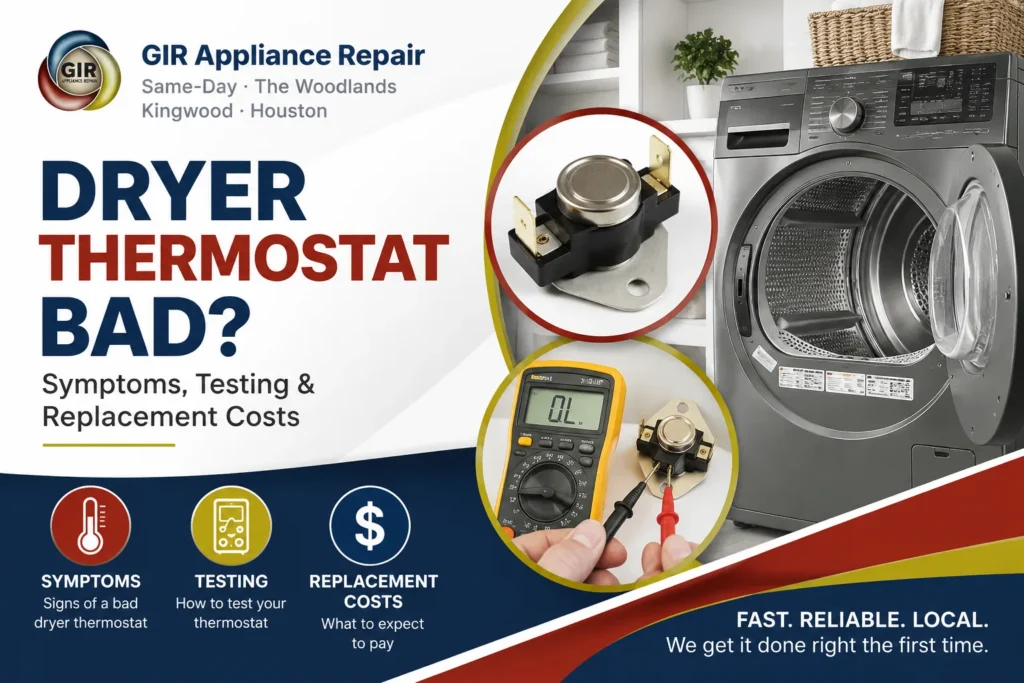
A dryer that runs cold, shuts off mid-cycle, or takes two or three runs to actually dry a load is one of the most common service calls GIR Appliance Repair handles across Houston, The Woodlands, Kingwood, Spring, and Conroe — and in a large share of those calls, the part at fault is the thermostat. Most dryers actually use two or three separate thermostats for different jobs, and knowing which one has failed (and what it actually does) makes the difference between a $90 fix and guessing your way through an expensive parts order. This guide breaks down dryer thermostat symptoms, how to test one, and what replacement typically costs.
Dryer Thermostat Symptoms & Likely Causes
| Symptom | Likely Cause | Est. Repair Cost |
|---|---|---|
| Dryer runs but produces no heat | High-limit thermostat has tripped open and failed to reset | $90–$220 |
| Clothes come out too hot or scorched | Cycling thermostat stuck closed, letting heat run continuously | $90–$210 |
| Dryer shuts off completely mid-cycle | High-limit safety thermostat tripping from restricted airflow | $90–$230 |
| Clothes take two or three cycles to dry | Cycling thermostat misreading temperature, ending heat cycles too early | $90–$210 |
| Burning smell along with no-heat symptoms | Restricted venting has overheated and tripped the thermal fuse alongside the thermostat | $100–$260 |
Your Dryer Has More Than One Thermostat
Most residential dryers use two distinct thermostats plus a one-time thermal fuse, and confusing them is the most common mistake in DIY dryer repair. The cycling thermostat is the one doing normal work — it turns the heating element on and off throughout a cycle to maintain the selected temperature. The high-limit thermostat is a safety device that only trips if the dryer overheats well beyond normal operating range, usually because of restricted airflow. A third component, the thermal fuse, is a one-time safety device (not a thermostat, and not resettable) that blows if temperatures get dangerously high and always needs replacing, never resetting. Because all three sit near each other on the blower housing or duct, and because a failure in one is often caused by the same root problem, it’s common for a technician to test and sometimes replace more than one at once.
No Heat: Almost Always the High-Limit Thermostat or Thermal Fuse
When a dryer tumbles normally, runs its full cycle, but produces zero heat, the high-limit thermostat or thermal fuse is the first thing GIR technicians check. Both are safety devices designed to cut power to the heating element if temperatures climb too high, which most often happens when a clogged lint screen, crushed vent duct, or a bird’s nest in the exterior vent restricts airflow. The heating element still works fine electrically — it’s simply been cut off by a safety device doing its job. Replacing the thermostat or fuse without also clearing the airflow restriction that caused it to trip in the first place is a common mistake that leads to the same failure repeating within weeks.
Clothes Coming Out Too Hot: The Cycling Thermostat
A cycling thermostat that’s stuck in the closed position keeps the heating element powered longer than it should, which shows up as unusually hot clothes, a hot-to-the-touch dryer cabinet, or in more advanced cases, scorched fabric on delicate items. This is different from a high-limit failure because the dryer keeps running and producing heat — it just doesn’t regulate it correctly. Left unaddressed, a stuck cycling thermostat puts extra strain on the heating element and increases fire risk from sustained high temperatures, so it’s worth addressing promptly rather than just running shorter cycles as a workaround.
How to Test a Dryer Thermostat
Thermostats are tested with a multimeter set to continuity or resistance mode, checked at room temperature with the dryer unplugged. A working cycling thermostat should show continuity (a closed circuit) at room temperature; a working high-limit thermostat typically shows continuity as well, since it’s only designed to open when overheated. No continuity on either at room temperature generally means it’s failed and needs replacing. The harder part isn’t the test itself — it’s knowing which of the two or three components near the blower housing to test first, and ruling out that a clogged vent (not a bad part at all) is the real cause. This is where a lot of DIY attempts go sideways: a homeowner replaces a thermostat, the dryer works for a few loads, and then it trips again because the actual airflow restriction was never cleared.
Repair Costs & What Affects Them
Thermostat and thermal fuse repairs are on the lower end of dryer repair costs, typically $90–$260 depending on the brand, whether one or multiple components need replacing, and whether a vent-clearing service is needed alongside the part replacement. If restricted airflow caused the failure, GIR technicians will flag that and recommend a vent cleaning so the new part doesn’t fail again for the same reason within a few months.
Preventing Repeat Thermostat Failures
Cleaning the lint screen before every load, having the full exterior vent duct professionally cleaned every one to two years, and avoiding overloading the dryer all reduce the airflow restriction that causes most high-limit thermostat trips. Homes in Spring, Conroe, and The Woodlands with longer duct runs to an exterior wall are especially prone to lint accumulation over time and benefit from more frequent vent cleaning than the national average recommendation.
Gas vs. Electric Dryers: Does It Matter?
The thermostat and thermal fuse setup is essentially identical between gas and electric dryers, since both use the same electrical safety and cycling controls regardless of what heats the air — a gas burner or an electric heating element. Where gas dryers differ is that a no-heat symptom has one additional possible cause beyond the thermostat: the gas valve solenoid or igniter can fail independently of the thermostat system entirely. A technician diagnosing a gas dryer with no heat will typically check both systems, since a failed igniter with a perfectly good thermostat produces the exact same “runs but no heat” symptom as a tripped high-limit thermostat.
Why Replacing Just One Part Sometimes Doesn’t Fix It
A frustrating pattern GIR technicians see is a homeowner who orders and replaces a thermal fuse themselves after researching the symptom online, only to have the dryer trip again within a load or two. This almost always means the underlying airflow restriction — a clogged vent, a crushed duct behind the dryer, or a lint-packed exterior vent cap — was never addressed, so the new fuse trips for the same reason the old one did. Thermostats and thermal fuses are symptom-level fixes; if the dryer keeps overheating, the real fix is clearing whatever’s restricting airflow, and a technician diagnosing a repeat failure will always check vent condition before assuming a defective replacement part.
Signs Your Dryer Vent Needs Cleaning, Not Just a New Thermostat
A few clues point toward a vent problem as the root cause rather than a simple worn-out part: cycles that have been gradually taking longer to dry clothes for weeks before the no-heat symptom appeared, a burning or hot dust smell during operation, the outside of the dryer cabinet feeling unusually hot, or a vent hood flap outside the house that barely moves during a cycle. Any of these alongside thermostat-tripping symptoms is a strong signal to have the full vent run inspected and cleaned as part of the repair, not just the thermostat replaced.
🔧 Need a professional repair?
GIR Appliance Repair serves Houston, The Woodlands & Kingwood — same-day availability.
What to Expect From a Service Visit
A typical thermostat-related service call starts with the technician confirming the symptom pattern (no heat, overheating, or intermittent shutoff), then removing the rear or front panel to access the blower housing where the cycling thermostat, high-limit thermostat, and thermal fuse are usually clustered together. Each is tested with a multimeter, the vent system is inspected for restriction, and any failed components are replaced in the same visit along with a recommendation on vent cleaning if that’s contributing to the problem. Most thermostat repairs are completed within an hour once the technician is on site.
Frequently Asked Questions
How do I know if my dryer thermostat is bad?
No heat at all, clothes coming out too hot, the dryer shutting off mid-cycle, or needing multiple cycles to dry a load are all classic thermostat symptoms. Which symptom you have narrows down which of the two thermostats is likely at fault.
What’s the difference between a cycling thermostat and a high-limit thermostat?
The cycling thermostat regulates normal heat during a cycle. The high-limit thermostat is a safety device that cuts power if the dryer overheats, usually from restricted airflow. A no-heat dryer usually points to the high-limit; overly hot clothes usually point to the cycling thermostat.
Can I reset a tripped high-limit thermostat myself?
Some models reset automatically once they cool down; others need to be replaced once tripped. Either way, clearing the airflow restriction that caused the trip is essential, or the problem will repeat.
How much does dryer thermostat replacement cost?
Most repairs run $90 to $260 depending on the part(s) needed and whether vent cleaning is required. GIR diagnoses first and gives an upfront quote before starting any repair.
Do you offer same-day dryer repair?
In most cases, yes. Call (346) 625-4289 to check same-day availability for your address.
Dryer running cold or shutting off mid-cycle? Contact GIR online or call (346) 625-4289 for same-day thermostat diagnosis across Houston, The Woodlands, Kingwood, Spring, and Conroe.
Ready to schedule your repair?
We serve The Woodlands, Kingwood, Spring, Humble & greater Houston. Call or book online.