
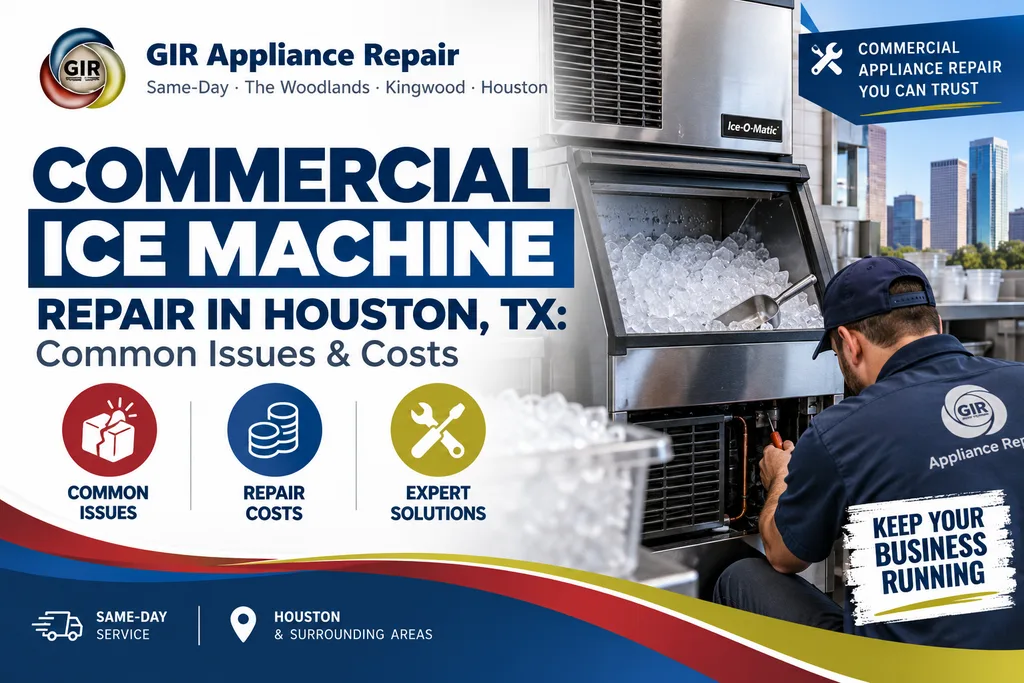
A commercial ice machine that’s not producing enough ice, running cloudy or oddly-shaped cubes, or has stopped making ice entirely is a different repair job than a home refrigerator’s built-in ice maker — and it’s one of the most urgent calls GIR Appliance Repair gets from Houston-area restaurants, bars, and convenience stores. Unlike a residential ice maker, a commercial unit is often the difference between a restaurant staying open for service or turning away customers, so downtime cost matters as much as the repair itself.
If you’re searching for commercial ice machine repair in Houston because your unit has slowed production, is throwing an error code, or has stopped making ice completely, this guide covers the most common commercial ice machine problems, what typically causes each one, realistic repair costs, and how to tell when a repair still makes sense versus replacing an aging unit.
Commercial Ice Machine Problems & Repair Costs
| Symptom | Likely Cause | Est. Repair Cost |
|---|---|---|
| No ice production | Failed compressor, bad water inlet valve, refrigerant leak | $300–$750 |
| Slow or reduced ice production | Dirty condenser coils, scale buildup on evaporator plate, low refrigerant | $180–$450 |
| Cloudy or soft ice cubes | Mineral scale buildup, water filter overdue, low water flow | $150–$350 |
| Undersized or malformed cubes | Faulty water inlet valve, worn hot gas valve, thermostat drift | $200–$420 |
| Water leaking onto the floor | Cracked water line, failed drain pump, clogged drain | $160–$380 |
| Error code on control board | Sensor, control board, or wiring fault — varies by manufacturer | $200–$550 |
| Loud grinding or buzzing noise | Worn compressor mount, failing fan motor, bad water pump | $200–$500 |
Why Commercial Ice Machines Stop Producing Ice
When a commercial ice machine stops making ice entirely, the most common causes are a failed water inlet valve that can’t supply the evaporator plate, a compressor that’s reached the end of its service life, or a refrigerant leak that’s slowly starved the system of cooling capacity. A technician can usually isolate the cause within the first 20–30 minutes on site by checking water pressure at the inlet valve and running an amp-clamp test on the compressor circuit. A failed inlet valve is a same-visit fix; a compressor replacement is a bigger repair worth weighing against the unit’s age and remaining service life.
More often, a commercial unit is still running but producing noticeably less ice than it used to. This is almost always tied to maintenance: condenser coils clogged with kitchen grease and dust block heat dissipation, and mineral scale builds up on the evaporator plate in Houston’s notoriously hard water, both of which force the compressor to work harder for less output. Left unaddressed, both problems accelerate compressor wear and shorten the machine’s lifespan. For related cooling failures on the refrigeration side of a kitchen, see our guide to freezer not freezing.
Water Quality & Scale: The Houston-Specific Problem
Houston’s hard water is one of the single biggest drivers of commercial ice machine service calls in this market. Mineral deposits build up on the evaporator plate and in the water lines faster here than in many parts of the country, and that scale buildup is what typically causes cloudy, soft, or oddly-shaped cubes even when the compressor and refrigerant system are working correctly. Restaurants and bars that don’t run a scheduled descaling and filter-replacement program tend to see ice quality complaints and reduced output well before any major component actually fails — a preventable service call that costs far less than an emergency no-ice visit during a Friday dinner rush.
Downtime Cost: Why Commercial Ice Machine Repair Is Time-Sensitive
A residential ice maker failure is an inconvenience; a commercial ice machine failure is a business problem. Bars run out of ice for drinks within hours, restaurants can’t hold perishables or serve iced beverages at volume, and many health code requirements assume a working ice supply for food safety practices. That’s why GIR prioritizes same-day diagnostic visits for commercial ice machine calls across Houston, The Woodlands, Kingwood, Spring, and Conroe — a fast, accurate diagnosis matters more here than almost any other appliance repair category, since every hour of downtime has a direct revenue impact.
Common Commercial Ice Machine Brands We Service
GIR technicians repair commercial ice machines across the manufacturers most common in Houston-area foodservice, including Manitowoc, Hoshizaki, Scotsman, and Ice-O-Matic, along with the ice machine units built into commercial refrigeration lines from Hoshizaki and Manitowoc. Modular ice machines (a separate ice-making head mounted over a bin) and self-contained undercounter units both use the same core refrigeration architecture, but bin-style modular units add sensors and control logic to manage ice level in the storage bin — a common source of error codes that don’t actually indicate a mechanical failure.
How Long Do Commercial Ice Machines Last?
A well-maintained commercial ice machine typically lasts 8–12 years with regular descaling, filter changes, and condenser cleaning. The compressor is usually the component that determines end-of-life, similar to residential refrigeration — a healthy compressor paired with a failed peripheral part (water valve, control board, fan motor) is almost always worth repairing, while a failed compressor on a unit already past 10 years old is the point where GIR technicians will typically walk operators through a repair-versus-replace comparison rather than automatically recommending the repair.
Checks Before You Call
- Confirm the unit is plugged in and the water supply valve behind it is fully open.
- Check that the bin control switch hasn’t been bumped to the off position.
- Look for visible ice buildup blocking the harvest cycle or bin sensor.
- Check the water filter’s last change date — most commercial units need a filter change every 6 months.
- Note any error code shown on the control board along with the model and serial number before calling.
If none of these resolve the issue, the problem is almost always internal — refrigerant systems, sealed compressors, and control boards should always be handled by a licensed technician, both for food-safety compliance and to avoid voiding any remaining manufacturer or service warranty.
Why Choose GIR for Commercial Ice Machine Repair
GIR Appliance Repair technicians diagnose the actual root cause before recommending any repair, carry common commercial ice machine parts on our trucks, and back every repair with a workmanship warranty. We offer same-day and next-day commercial appointments across Houston, The Woodlands, Kingwood, Spring, and Conroe, with priority scheduling for foodservice businesses that can’t afford extended downtime.
Every technician arrives with a multimeter, amp clamp, and refrigerant gauges so the diagnosis is based on measured readings rather than guesswork — which means an accurate quote the first time, not a series of trial-and-error part swaps billed one at a time. With 264+ Google reviews and a 4.9-star rating, GIR has built its reputation on getting commercial refrigeration repairs right on the first visit. For related commercial refrigeration needs, see our guide to commercial walk-in cooler repair.
🔧 Need a professional repair?
GIR Appliance Repair serves Houston, The Woodlands & Kingwood — same-day availability.
Frequently Asked Questions
How much does commercial ice machine repair cost?
Most repairs range from $150 to $750 depending on the failed component. Compressor and refrigerant repairs are on the higher end; water valves, filters, and control sensors are typically under $450. We always diagnose first and quote before repairing.
Why is my commercial ice machine making cloudy ice?
Cloudy or soft ice is almost always a water quality issue — mineral scale buildup or an overdue water filter, both common in Houston’s hard water, rather than a mechanical failure.
How often should a commercial ice machine be descaled?
Most manufacturers recommend descaling every 6 months in normal water conditions, and as often as every 3–4 months in areas with harder water like Houston.
Is it worth repairing a commercial ice machine over 8 years old?
Usually, yes, unless the compressor itself has failed. A $200–$450 repair on an otherwise healthy 8-year-old unit is almost always cheaper than a $3,000+ replacement.
Do you offer same-day commercial ice machine repair in Houston?
Yes, in most cases, with priority scheduling for restaurants and bars. Call (346) 625-4289 to check same-day availability for your Houston-area address.
Can I clean and descale a commercial ice machine myself?
Routine cleaning of exterior surfaces and the bin is fine, but a proper internal descale and refrigerant-system diagnosis should be handled by a licensed technician to avoid damaging food-contact components or masking a bigger mechanical issue.
Commercial ice machine down or making bad ice? Contact GIR online or call (346) 625-4289 for same-day service across Houston, The Woodlands, Kingwood, Spring, and Conroe.
Ready to schedule your repair?
We serve The Woodlands, Kingwood, Spring, Humble & greater Houston. Call or book online.