
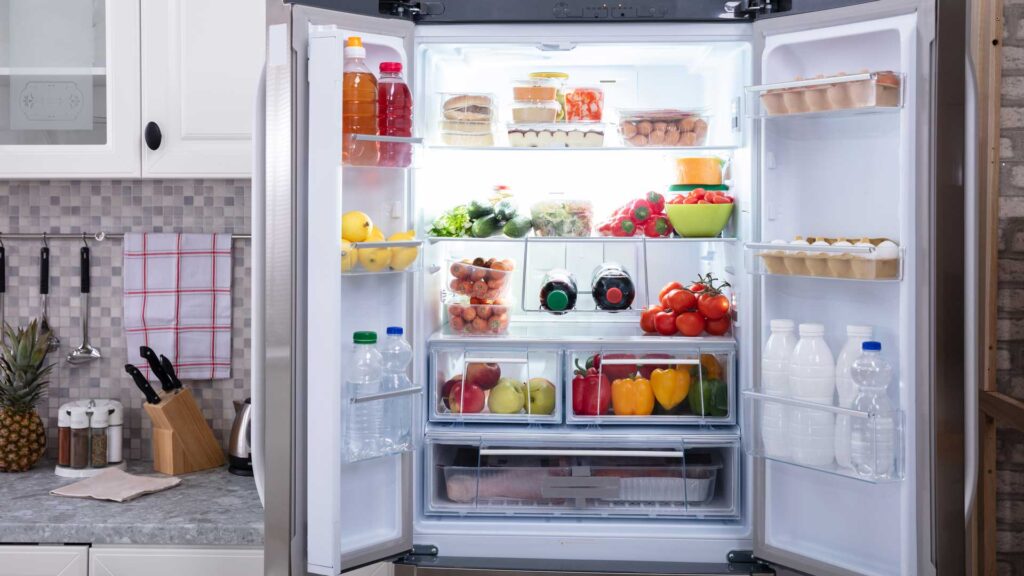
Lettuce frozen solid in the crisper. Milk with ice crystals on top. Or the opposite: yogurt that goes sour days early because the fridge warms up and cools down all day. Both problems come from the same place. Something in the refrigerator has lost track of what temperature it should hold. It’s one of the most common calls we get across Houston, The Woodlands, Spring, Kingwood and Conroe, and the good news is that it’s usually a sensor, a damper or an airflow problem, not a dying compressor. This guide walks you through what causes a fridge to run too cold or swing in temperature, what you can check yourself in ten minutes, and what a repair usually costs.
Too Cold or Swinging Temperatures: Symptoms & Likely Causes
| What you notice | Most likely cause | Est. Repair Cost |
|---|---|---|
| Food freezing at the back of the fridge, near the vent | Air damper stuck open, or items blocking the cold-air vent | $0 (rearrange) to $150–$280 |
| Whole fridge too cold, setting changes do nothing | Failed thermistor (temperature sensor) or thermostat | $120–$250 |
| Fridge cycles between too cold and too warm | Thermistor reading wrong, or a control board relay sticking | $150–$400 |
| Warm spells every few hours, frost on the freezer back panel | Defrost system failure choking airflow | $150–$350 |
| Condensation inside, temperature creeps up after door openings | Torn or loose door gasket | $100–$250 |
| Runs constantly, still can’t hold temperature | Dirty condenser coils, failing condenser fan, or a weak compressor | $0 (cleaning) to $400+ |
Prices are typical ranges for parts and labor in the Houston area. Your exact number depends on the model and the part, and we always give you the price before any work starts.
First, Check the Real Temperature
The dial or display on your fridge tells you what the fridge is trying to do, not what it’s actually doing. Before anything else, put an inexpensive appliance thermometer in a glass of water on the middle shelf and leave it overnight. Water gives a steadier reading than air, which changes every time the door opens.
- Fridge section: should read 37–40°F. Below 34°F, things start to freeze. Above 40°F, food spoils faster.
- Freezer: should read 0°F, give or take a couple of degrees.
If you see big swings when you check morning and evening, say 33°F one time and 45°F the next, you’re dealing with a temperature control problem, not just a setting that’s too low.
Why a Refrigerator Runs Too Cold
The air damper is stuck open
In most side-by-side and top-freezer refrigerators, the cold air is actually made in the freezer. A small flap called the damper opens and closes to let just enough of it into the fresh-food section. When the damper sticks open, which can happen because of ice, a broken flap or a failed motor, freezer air pours in non-stop and anything near the vent freezes. The classic sign is frozen food on the top shelf at the back while the door shelves stay normal.
The thermistor is giving bad readings
Modern fridges don’t use a mechanical thermostat. They use a thermistor, a small sensor that tells the control board how cold it is. When a thermistor drifts, the board believes the fridge is warmer than it really is and keeps cooling. A technician can check it in a few minutes with a meter by comparing its resistance to the chart for your model. The part itself is inexpensive, which makes this one of the more affordable fixes.
The control board or thermostat has failed
On older models with a mechanical thermostat, the contacts inside can weld shut, so the compressor never gets the signal to stop. On newer models, a relay on the main control board can do the same thing. In both cases the compressor runs and runs, and everything gets too cold. If adjusting the setting makes no difference at all, this is high on the list.
Food is blocking the vents
This one costs nothing to fix. A gallon of milk or a stack of containers pushed against the cold-air vent at the back creates a little ice zone right in front of it, and blocks circulation to the rest of the fridge at the same time. Leave a couple of inches of space in front of the vents and see if the problem goes away within a day.
Why a Refrigerator’s Temperature Keeps Swinging
A defrost problem is choking the airflow
Frost-free fridges melt the frost off the evaporator coil several times a day. If the defrost heater, timer or sensor fails, frost keeps building until it blocks the air path. The fridge cools fine for a while, then warms up as the coil ices over, and then cools again if the frost partly melts. If you remove the freezer’s back panel and see a solid sheet of white frost, that’s your answer. We cover it in detail in our guide to refrigerator defrost problems.
The evaporator fan is weak or noisy
The evaporator fan pushes the cold air around. When its motor starts to fail, it slows down or stops on and off, and the temperature follows. A buzzing or ticking sound from the back of the freezer is the usual giveaway. See our full guide on evaporator fan symptoms and fixes.
Door seals are letting warm air in
A worn gasket lets humid air in every minute of the day. The fridge works harder, frost builds faster, and the temperature climbs every time someone opens the door. Try the dollar-bill test: close the door on a bill and pull it out. If it slides out with no resistance, the seal isn’t doing its job at that spot. Our door seal guide explains when cleaning is enough and when it needs to be replaced.
The condenser coils can’t shed heat
The coils under or behind the fridge release the heat pulled out of the inside. When they’re coated in dust and pet hair, the system can’t keep up on hot afternoons, and the temperature drifts up until evening. In Houston summers, with the garage or kitchen sitting at 85°F or more, this shows up fast. Cleaning them takes ten minutes. Here’s how to clean your fridge coils.
🔧 Need a professional repair?
GIR Appliance Repair serves Houston, The Woodlands & Kingwood — same-day availability.
What You Can Check Yourself in 10 Minutes
- Check the setting. Kids, guests and cleaning sometimes bump a dial. Most fridges are happiest at the middle setting, or 37°F on a digital display.
- Clear the vents. Move food away from the cold-air vent at the back of the fridge and the vents inside the freezer.
- Test the door seals with the dollar-bill test around all four sides.
- Clean the condenser coils with a coil brush or vacuum. Unplug the fridge first.
- Listen at the back of the freezer. A steady fan sound is good. Buzzing, ticking or silence while the compressor runs points to the fan.
- Give it 24 hours after any change and check your thermometer again. Fridges adjust slowly.
If the temperature is still wrong after these steps, the cause is almost certainly a part: a damper, a sensor, the defrost system or the control board. That’s the point where a technician with a meter saves you from guessing and buying parts you don’t need.
How We Diagnose It
When we come out, we start by measuring the actual temperatures in both compartments and watching how the fridge behaves through a cycle. Then we test the parts in order of likelihood: the thermistor’s resistance, the damper’s movement, the evaporator fan, the defrost heater and sensor, and finally the control board’s outputs. Most temperature problems are pinned down within the first visit, and because our vans carry common sensors, dampers and fan motors for the major brands, many are fixed the same day.
Repair or Replace?
For a fridge under 10 years old, a temperature control repair almost always makes sense. Sensors, dampers and fans are inexpensive compared to a new refrigerator. It gets closer to a judgment call when the compressor itself is failing on an older unit, or when a control board for a high-end model costs more than half the price of a comparable new fridge. We’ll tell you honestly which side of that line you’re on. Not sure how old your fridge is? Our free appliance age lookup reads it from the serial number.
Temperature Problems in Houston-Area Homes
Heat and humidity make every one of these problems worse. A fridge in a warm garage in Spring or Conroe works much harder than the same model in an air-conditioned kitchen, and humid air means more frost, which means the defrost system works harder too. If your fridge lives in the garage, check the manual’s ambient temperature range. Many models aren’t designed for a 95°F garage, and a “garage-ready” refrigerator may solve a problem that no repair will.
What Happens If You Wait
A fridge that runs too cold wastes food and electricity, and the compressor runs far more than it should, which shortens its life. A fridge that swings warm is a food-safety problem: the USDA guidance is that perishable food above 40°F for more than two hours should be thrown out. Either way, the small part that’s failing today tends to put stress on bigger, more expensive parts if it’s left alone.
Frequently Asked Questions
Why is my fridge freezing food when it’s set to normal?
Usually it’s a damper stuck open, a thermistor giving wrong readings, or food blocking the cold-air vent. Clear the vent first. If food keeps freezing after a day, a part needs testing.
Why does my refrigerator temperature go up and down?
The most common causes are a failing defrost system, a weak evaporator fan, a worn door seal or dirty condenser coils. A thermometer reading in the morning and evening helps a technician narrow it down quickly.
How much does it cost to fix a fridge that’s too cold?
Most repairs fall between $120 and $280 for a sensor or damper. Control board replacements run higher, typically $250–$400 depending on the model.
Can I keep using my fridge while I wait for a repair?
Yes, if you keep an eye on the thermometer. If the fridge section stays above 40°F, move perishables to a cooler with ice until it’s fixed.
Need Help With a Fridge That Won’t Hold Temperature?
GIR Appliance Repair serves Houston, The Woodlands, Spring, Kingwood, Humble and Conroe, often the same or next day. Call or text (346) 625-4289, or book on our refrigerator repair page. If you’re in the area, our Woodlands and Spring technicians are usually closest.
Ready to schedule your repair?
We serve The Woodlands, Kingwood, Spring, Humble & greater Houston. Call or book online.