

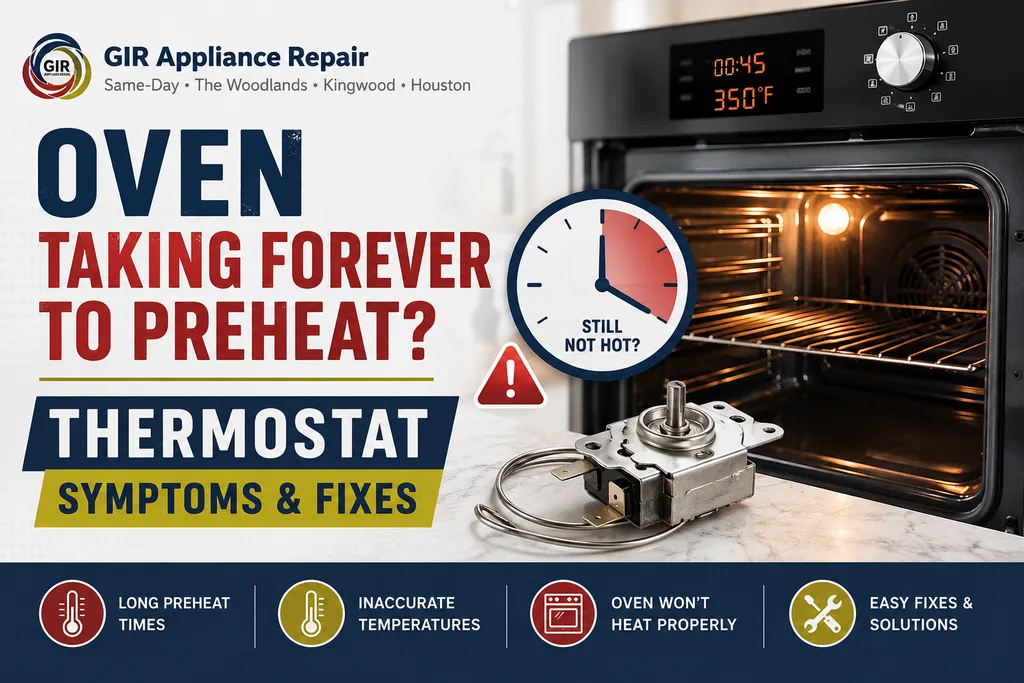
An oven that takes 20, 30, or even 40 minutes to preheat — when it used to take 10 — is a gradual problem that a lot of Houston-area homeowners live with for months before calling GIR Appliance Repair, usually because the oven does eventually get hot and nothing seems obviously “broken.” But a slow preheat is almost always a sign that the thermostat or temperature sensor is misreading the oven’s actual temperature, and it tends to get worse over time rather than better. This guide covers why ovens slow down, how to tell if the thermostat is the cause, and what repair typically involves.
Oven Preheat & Thermostat Symptoms
| Symptom | Likely Cause | Est. Repair Cost |
|---|---|---|
| Preheat takes 25+ minutes but oven does get hot | Temperature sensor drifting out of calibration | $100–$240 |
| Food consistently over- or under-cooks at the set temperature | Sensor or thermostat reading incorrectly | $100–$240 |
| Oven never reaches set temperature at all | Failed bake element or failed thermostat/sensor | $120–$280 |
| Temperature swings noticeably during cooking | Faulty thermostat cycling the element on/off incorrectly | $110–$250 |
| “F” error code or preheat indicator never turns off | Sensor sending an invalid reading to the control board | $110–$260 |
Sensor vs. Thermostat: What’s Actually Different
Older ovens use a mechanical thermostat — a bulb-and-capillary-tube device that expands with heat to physically open and close a switch. Most ovens built in the last 15–20 years instead use an electronic temperature sensor, a metal probe visible inside the oven cavity that reports temperature to the control board, which then cycles the heating element to hold the set point. Electronic sensors are generally more accurate when new, but like any electronic component they can drift out of calibration or fail outright over years of heat cycling. Whichever type your oven has, the symptom is the same from the outside: the oven’s actual temperature no longer matches what the dial or display says.
Why Slow Preheat Usually Means Sensor Drift, Not a Dead Element
A completely dead bake element produces a clear symptom — the oven never gets hot at all, or you can visually see the element isn’t glowing red during bake mode. Gradual, worsening preheat time is different: the element is still working, but the sensor is reporting a temperature that’s higher than the oven’s actual temperature, so the control board cuts power to the element too early, again and again, stretching out how long it takes to actually reach 350°F even though the display eventually says it’s ready. This drift tends to happen slowly, which is exactly why so many homeowners notice preheat “getting a little longer” for weeks before finally addressing it.
Testing an Oven Temperature Sensor
The most reliable way to confirm sensor drift without any tools is a simple oven thermometer: set the oven to 350°F, let it fully preheat, and compare the thermometer’s reading to the display. A difference of more than about 25°F points to a sensor or thermostat problem rather than normal variation. For a more precise diagnosis, technicians test the sensor’s resistance with a multimeter at a known oven temperature and compare it against the manufacturer’s specification — sensors have a predictable resistance curve, and a reading outside that curve confirms the part has failed rather than just needing recalibration.
Some Ovens Have a Built-In Calibration Setting
Many electronic ovens include a hidden calibration menu (often accessed by holding the Bake and a temperature arrow button simultaneously, though the exact combination varies by brand) that lets you offset the displayed temperature by up to 30–35°F in either direction. If an oven thermometer test shows a consistent, moderate difference, adjusting this calibration setting can resolve the issue without any parts at all. It’s worth checking the owner’s manual for your specific model before assuming a sensor replacement is needed — though if the drift is larger than the calibration range allows, or the temperature swings unpredictably rather than being consistently off by the same amount, the sensor itself likely needs replacing.
Repair Costs & What Affects Them
Temperature sensor and thermostat repairs typically run $100 to $280 depending on the brand and whether the bake element also needs replacing. Sensors are generally straightforward, affordable parts; a full thermostat assembly on older mechanical-thermostat ovens can run slightly higher due to more involved access and calibration afterward.
Gas vs. Electric Ovens: Where the Sensor Sits
On electric ovens, the temperature sensor is almost always a visible metal probe mounted near the top rear of the oven cavity, away from direct contact with the heating element, so a drifting reading is nearly always the sensor itself rather than anything mechanical. Gas ovens more commonly use an older-style mechanical thermostat with a capillary tube rather than an electronic sensor, and the failure mode is slightly different — rather than gradual drift, a mechanical thermostat tends to fail more abruptly once the sealed gas or liquid inside the capillary tube starts to leak, which is why gas oven temperature problems sometimes appear more suddenly than the gradual worsening typical of electric sensor drift.
When It’s Not the Sensor: Convection Fan & Door Seal Issues
If an oven thermometer test shows accurate temperature but preheat still feels unusually slow, it’s worth ruling out two other culprits before assuming a sensor problem: a convection fan that’s stopped working (on ovens with convection features, the fan helps circulate hot air faster during preheat, and a dead fan motor can meaningfully slow things down even with a perfectly good heating element and sensor), and a worn door gasket that’s letting heat escape faster than the element can replace it. Both are worth a quick visual and physical check — listening for the fan running during preheat, and feeling around the door edge for escaping heat — before ordering a sensor replacement that may not be the actual cause.
Why Consistent Testing Matters More Than a One-Time Check
A single oven thermometer reading can be misleading if it’s taken during a moment when the thermostat happens to be cycling the element on or off, since actual oven temperature naturally swings a few degrees above and below the set point throughout a normal cycle even on a perfectly healthy unit. For a more reliable read, check the thermometer two or three times over a 10-minute period after the “preheated” indicator goes off, and average the readings. A sensor that’s truly drifted will show a consistent gap across all readings, while normal cycling variation will show readings both above and below the set point.
Double Ovens & Multi-Sensor Systems
Double wall ovens use a completely separate sensor and control system for each cavity, which means it’s entirely possible for the upper oven to preheat normally while the lower one has drifted, or vice versa. If you’re only noticing the slow-preheat symptom in one of the two cavities, that’s a useful diagnostic clue on its own — it points specifically to that cavity’s sensor rather than a shared component, and simplifies the repair to a single-sensor replacement rather than needing to test both systems.
🔧 Need a professional repair?
GIR Appliance Repair serves Houston, The Woodlands & Kingwood — same-day availability.
How Long Sensor Replacement Takes
Once a technician has confirmed the sensor as the cause, replacement itself is typically a straightforward 30–45 minute repair, since the sensor is usually secured with one or two screws and a plug-in connector rather than requiring deeper disassembly of the oven cavity. The bulk of a service visit’s time goes toward confirming the diagnosis with testing rather than the physical replacement itself, which is part of why an accurate oven-thermometer test before the appointment can sometimes speed up the visit.
Frequently Asked Questions
Why does my oven take so long to preheat?
In most cases, the temperature sensor or thermostat is misreading the oven’s actual temperature, causing the control board to cut power to the heating element earlier than it should, again and again, which stretches out preheat time even though the oven eventually reaches temperature.
How can I test if my oven thermostat is broken?
The easiest home test is an oven thermometer: preheat to 350°F and compare its reading to the display. A gap of more than about 25°F points to a sensor or thermostat issue.
Can I fix a slow-preheating oven without replacing parts?
Sometimes. Many ovens have a hidden calibration setting that can offset a moderate temperature discrepancy without any parts needed. If the drift is larger or inconsistent, the sensor itself likely needs replacing.
How much does oven sensor replacement cost?
Most repairs run $100 to $280 depending on brand and whether other components need replacing. GIR always diagnoses first and provides an upfront quote before starting any repair.
Is a slow-preheating oven safe to keep using?
Generally yes in the short term, though food may cook unevenly. If the oven eventually stops reaching temperature at all, that’s a sign to schedule service before it fails completely.
Oven taking too long to preheat, or cooking unevenly? Contact GIR online or call (346) 625-4289 for same-day sensor and thermostat diagnosis across Houston, The Woodlands, Kingwood, Spring, and Conroe.
Ready to schedule your repair?
We serve The Woodlands, Kingwood, Spring, Humble & greater Houston. Call or book online.