

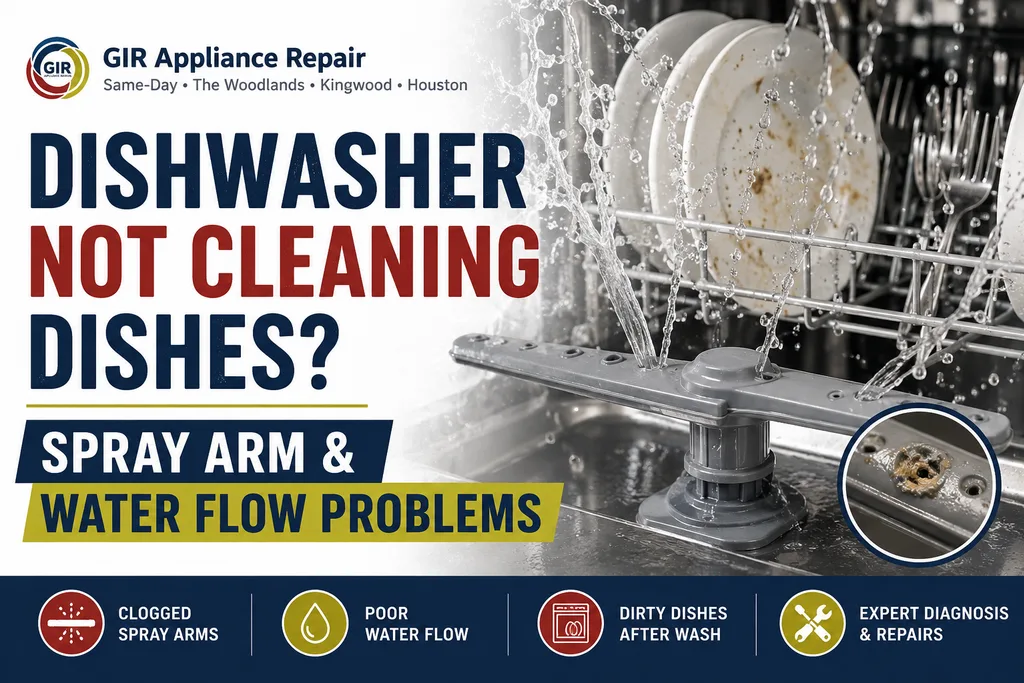
Dishes coming out of the dishwasher with dried food still stuck on them, or a chalky film covering everything even after a full cycle, is one of the most common complaints GIR Appliance Repair hears from Houston-area homeowners — and the cause is frequently something inside the tub itself, not a plumbing or detergent problem. The spray arms are the rotating plastic wands that shoot water up, down, and sideways across every rack, and when they stop spinning freely or get clogged, cleaning performance drops across the entire load, not just in one spot. This guide covers what stops a spray arm from spinning, how to fix the common causes yourself, and when it’s a sign of a deeper problem.
Dishwasher Spray Arm Symptoms & Likely Causes
| Symptom | Likely Cause | Est. Repair Cost |
|---|---|---|
| Top rack dishes stay dirty, bottom rack fine | Upper spray arm clogged or not receiving enough water pressure | $0–$140 (often DIY) |
| Entire load comes out dirty or filmy | Clogged food filter restricting water to all spray arms | $0–$130 (often DIY) |
| Spray arm doesn’t spin at all when checked mid-cycle | Arm physically blocked by a tall item, or cracked mounting hub | $90–$210 |
| Grinding or rattling noise during wash | Debris caught in the spray arm or wash impeller | $0–$150 |
| Weak, dribbling water instead of a strong spray pattern | Failed wash pump or motor not building sufficient pressure | $150–$320 |
Clogged Spray Arm Holes: The #1 Cause
Each spray arm has a row of small holes that shoot water at specific angles to cover the whole rack as it spins — and hard water minerals, along with food debris that slips past the filter, gradually clog these holes over months of use. A partially clogged spray arm doesn’t stop spinning; it just sprays less water, less evenly, which shows up as certain dishes or certain areas of a rack staying dirty while others come out clean. This is easy to check and fix at home: remove the spray arm (most simply lift or unscrew off), and use a toothpick or thin wire to clear each hole, then soak the arm in a vinegar solution for an hour if mineral buildup is heavy.
Clogged Filter Restricting Water to Every Arm
Modern dishwashers filter wash water through a removable food filter assembly at the bottom of the tub before recirculating it back through the spray arms. When this filter gets clogged with food particles, every spray arm receives less water pressure, which produces the “whole load came out dirty” symptom rather than a localized problem. Most manufacturers recommend removing and rinsing this filter every one to two weeks depending on how much food scraping happens before loading — a maintenance step that’s easy to skip but is, by a wide margin, the most common fix for consistently poor cleaning performance.
Physically Blocked or Jammed Spray Arms
Tall items like a wine glass stem, a utensil handle poking through the rack, or a large pot lid can physically block a spray arm from completing its rotation. This produces a distinct symptom from clogging: instead of weak, uneven spray, the arm may not turn at all, and dishes directly beneath the blocked arm come out completely untouched by water. It’s worth opening the dishwasher partway through a cycle occasionally to visually confirm both arms are spinning freely, especially after loading unusually shaped items.
Cracked Hub or Failed Wash Pump
If the spray arm holes are clear and nothing is blocking its rotation but it still won’t spin, the mounting hub that connects the arm to the wash system can crack from age, or the wash pump/motor that pressurizes the water supply to the arms can fail outright. A failed pump produces a distinctly different symptom than a clog: water flow is weak or absent across the entire tub rather than just uneven, sometimes accompanied by a hum from the motor without any spray happening at all. This is the point where the issue moves from a DIY fix to a repair, since accessing and replacing a wash pump requires disassembling the tub’s lower section.
DIY vs. Calling a Professional
Clearing clogged holes and rinsing the filter are genuinely DIY-friendly, take under 15 minutes, and resolve the majority of poor-cleaning complaints GIR sees. Where it’s worth calling a technician is when the arms are confirmed clear and unobstructed but the dishwasher still isn’t cleaning well — at that point, the wash pump, motor, or a water inlet issue is the more likely cause, and those repairs require the tub’s lower assembly to be opened correctly to avoid damaging seals or wiring.
Hard Water & Spray Arm Buildup in the Houston Area
Water hardness varies significantly across the Houston metro, and neighborhoods on well water or with harder municipal supply see mineral buildup inside spray arm holes and on the interior of the dishwasher tub considerably faster than areas with softer water. If dishes routinely come out with a white, chalky film even when they’re not touching each other in the rack, that’s a strong sign of hard water mineral deposits rather than a cleaning or clogging issue specifically — running an empty cycle with a citric-acid-based dishwasher cleaner every month or two, in addition to regular spray arm and filter cleaning, makes a noticeable difference in homes with harder water.
Upper vs. Lower Spray Arm: Different Symptoms, Different Fixes
Most dishwashers have at least two spray arms — a lower arm mounted at the bottom of the tub and an upper arm below or as part of the top rack — and sometimes a third mid-level arm on higher-end models. Because the lower arm handles most of the water volume and is closest to the pump, a lower arm problem tends to affect the entire load’s cleaning performance. An upper arm problem, by contrast, usually only affects the top rack specifically, since the upper arm relies on water being pushed further against gravity and is more sensitive to any reduction in pressure. Identifying which rack is affected is one of the fastest ways to narrow down which arm needs attention before even opening the dishwasher.
Preventing Spray Arm Problems Going Forward
Beyond the every-one-to-two-weeks filter rinse, scraping large food particles off dishes before loading (rather than relying entirely on the dishwasher’s filter to catch everything) meaningfully reduces how quickly both the filter and spray arm holes clog. It’s also worth periodically checking that nothing in the lower rack is positioned to block the spray arm’s rotation path, since a single misplaced pan or utensil handle can silently reduce cleaning performance for an entire cycle without being obvious until you check.
Newer Dishwashers With Dedicated Wash Zones
Many higher-end dishwashers built in the last several years include dedicated wash zones or a dual-spray-arm top rack designed for glasses and delicate items, which use smaller, more precisely angled spray nozzles than a standard arm. These finer nozzles clog faster than a standard spray arm’s larger holes, so if you own a dishwasher with a specialty wash zone and notice reduced performance specifically in that area, checking those smaller nozzles first — before assuming a pump or motor issue — often resolves it without a service call.
When Poor Cleaning Isn’t a Spray Arm Problem at All
Not every cleaning complaint traces back to the spray arms. Water temperature (dishwashers rely on hot water, typically 120°F, to activate detergent properly), old or improperly stored detergent, and an overloaded rack that blocks water paths between dishes can all produce similar symptoms to a clogged spray arm. If spray arms and filter are confirmed clean and unobstructed but cleaning performance is still poor, checking water heater temperature and detergent freshness are worthwhile next steps before assuming a mechanical failure.
🔧 Need a professional repair?
GIR Appliance Repair serves Houston, The Woodlands & Kingwood — same-day availability.
Frequently Asked Questions
Why are my top rack dishes still dirty?
This usually means the upper spray arm is clogged or not receiving full water pressure, often because the lower food filter needs cleaning or the upper arm’s holes have mineral buildup.
How do I clean dishwasher spray arm holes?
Remove the arm (most lift or twist off without tools), clear each hole with a toothpick or thin wire, and soak in a vinegar solution for an hour if there’s visible mineral buildup, then rinse and reinstall.
How often should I clean my dishwasher filter?
Every one to two weeks for most households, more often if dishes aren’t rinsed or scraped before loading. A clogged filter is the single most common cause of a whole load coming out dirty.
My spray arm won’t spin at all — what’s wrong?
Check first for a tall item physically blocking its rotation. If nothing is blocking it, a cracked mounting hub or failed wash pump is the likely cause and needs a technician diagnosis.
How much does dishwasher spray arm repair cost?
Many spray arm and filter issues are free DIY fixes. If a pump or motor replacement is needed, repairs typically run $150 to $320. GIR always diagnoses first and gives an upfront quote.
Dishwasher not cleaning like it used to? Contact GIR online or call (346) 625-4289 for same-day diagnosis across Houston, The Woodlands, Kingwood, Spring, and Conroe.
Bosch owner specifically? See our Bosch dishwasher repair guide for Bosch-specific error codes like E15 and E24.
Ready to schedule your repair?
We serve The Woodlands, Kingwood, Spring, Humble & greater Houston. Call or book online.