
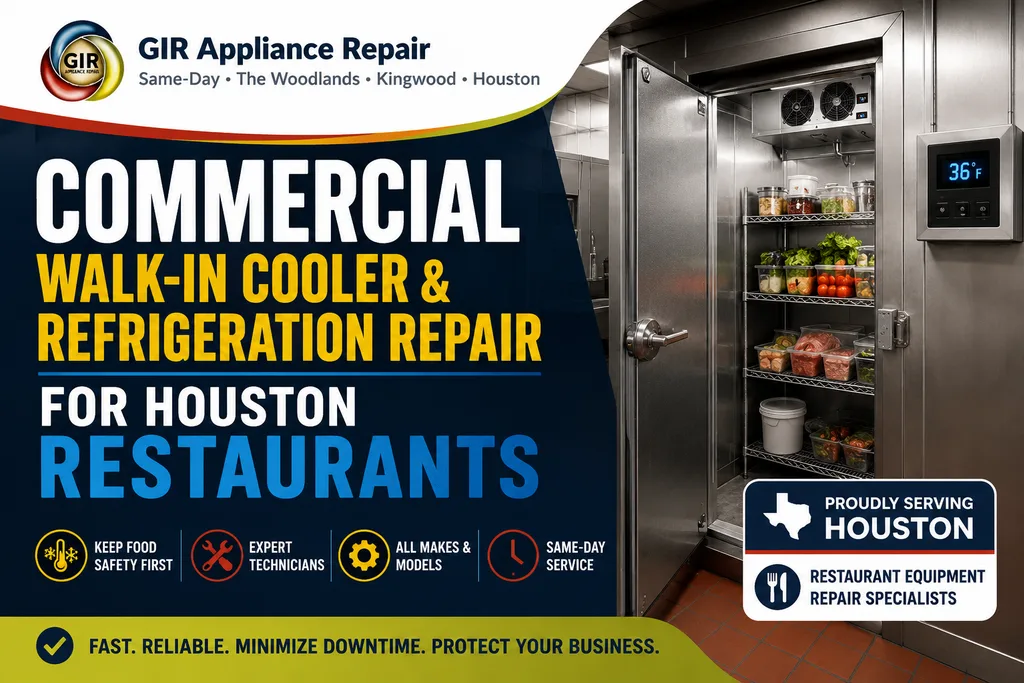
A walk-in cooler that’s running warm, cycling constantly, or forming heavy ice on the evaporator coil is more than an inconvenience for a Houston restaurant, bar, or catering kitchen — it’s a health-code and inventory-loss emergency measured in hours, not days. GIR Appliance Repair provides commercial refrigeration service across Houston, The Woodlands, Kingwood, Spring, and Conroe, and walk-in coolers and reach-in commercial refrigeration are among the most urgent calls we handle. This guide covers the most common walk-in cooler and commercial refrigeration failures, what causes them, and what to expect from a service call.
Walk-In Cooler Symptoms & Likely Causes
| Symptom | Likely Cause | Est. Repair Cost |
|---|---|---|
| Cooler running warm, compressor cycling constantly | Low refrigerant charge from a slow leak | $250–$650 |
| Heavy ice buildup on evaporator coil | Failed defrost heater, timer, or termination thermostat | $200–$480 |
| Compressor won’t start, or trips breaker repeatedly | Failed start relay/capacitor, or compressor itself failing | $300–$1,200+ |
| Water pooling on the floor inside the cooler | Clogged or frozen condensate drain line | $150–$320 |
| Door won’t seal tight, condensation around frame | Worn door gasket or misaligned door hinges | $180–$400 |
Why Response Time Matters More for Commercial Refrigeration
A residential fridge losing cooling for a few hours is a food-safety inconvenience for one household. A walk-in cooler at a restaurant losing cooling for the same amount of time can mean thousands of dollars in spoiled inventory and a potential health-code violation if temperatures aren’t restored and documented quickly. Because of this, commercial refrigeration calls are treated as a different priority tier than a standard residential appliance repair — GIR prioritizes same-day and emergency response for walk-in cooler and reach-in commercial refrigeration failures specifically because of how fast the cost of downtime compounds for a food-service business.
Refrigerant Leaks: The Most Common Cause of a Warm Walk-In
A walk-in cooler that runs constantly, never quite reaches its set temperature, and shows frost only on part of the evaporator coil rather than evenly is the classic signature of a slow refrigerant leak. Refrigerant doesn’t get “used up” during normal operation — if the charge is low, it’s leaking out somewhere in the line set, coil, or a fitting, and simply adding more refrigerant without finding and sealing the leak means the same problem returns within weeks or months. A proper repair involves leak detection (often with an electronic leak detector or UV dye), sealing or replacing the failed component, then recharging to the manufacturer’s specified charge and verifying performance.
Defrost System Failures & Heavy Ice Buildup
Like residential freezers, commercial walk-in coolers use a timed defrost cycle to melt frost off the evaporator coil before it restricts airflow. When the defrost heater, timer, or termination thermostat fails, ice builds up on the coil until it blocks airflow almost entirely, and the box slowly warms up even though the compressor is running. This is often mistaken for a refrigerant problem since the symptom (warm box, compressor running) looks similar, but the fix is different — and a technician needs to physically inspect the coil for ice to tell the two apart quickly.
Compressor Failures & Electrical Issues
A compressor that won’t start, hums without starting, or repeatedly trips the breaker points to either a failed start relay/capacitor (a comparatively inexpensive fix) or a failing compressor itself, which is the single most expensive component in the system to replace. Given the cost difference between these two outcomes, a proper electrical diagnosis before ordering any parts is essential — GIR technicians test the start components first, since replacing a capacitor is a fraction of the cost of a compressor and often turns out to be the actual fix.
Door Seals & Preventing Repeat Failures
A worn door gasket or misaligned hinge that lets warm, humid Houston air continuously leak into the box forces the compressor to run far more than it should, accelerating wear on every other component and driving up energy costs even when nothing has technically “failed” yet. Checking gasket condition and door alignment during routine maintenance is one of the most cost-effective ways a commercial kitchen can extend the life of its walk-in system and reduce the frequency of bigger repairs.
Documenting Downtime for Health Inspectors
When a walk-in cooler fails, health departments generally expect a restaurant to be able to show what temperature food was held at during the outage, how long it lasted, and what was done with any food that spent time above 40°F. GIR technicians provide a service record with arrival time, diagnosis, and repair completion time for every commercial refrigeration call specifically because that documentation matters for a kitchen manager who needs to show due diligence to a health inspector, not just get the box cold again.
Preventive Maintenance Contracts for Commercial Kitchens
Many of the emergency walk-in cooler calls GIR responds to trace back to a slow refrigerant leak, worn door gasket, or dirty condenser coil that had been developing for months before it finally caused a full failure — all things a routine maintenance visit would have caught early. For restaurants and catering operations that can’t afford unplanned downtime, a scheduled maintenance visit twice a year (checking refrigerant charge, door seals, condensate drains, and defrost operation) is significantly cheaper than an emergency after-hours service call plus the cost of lost inventory, and it’s worth asking about when scheduling your next repair.
Reach-In Units: Similar Failures, Faster Access
Reach-in commercial refrigerators and freezers share the same core failure points as walk-ins — refrigerant leaks, defrost system failures, and door seal wear — but with the advantage of easier component access since there’s no walk-in space to work around. This generally means faster repair times for reach-in units, though the urgency is the same: a reach-in unit holding perishable inventory for a working kitchen needs the same same-day priority as a full walk-in box.
Freezer vs. Cooler: Different Temperature Tolerances
Walk-in freezers run at 0°F or below and have a much smaller margin for error than walk-in coolers running at the standard 35–38°F range — a freezer that drifts even a few degrees warm can start compromising frozen inventory quality well before it reaches an unsafe temperature, while a cooler has slightly more buffer before food safety becomes an issue. Because of this tighter tolerance, freezer temperature complaints are treated with the same urgency as a cooler that’s fully warm, even if the freezer is still technically below freezing when the call comes in.
What a Typical Commercial Service Call Involves
A GIR technician arriving for a walk-in cooler call starts by checking the box’s current temperature against its set point, inspecting the evaporator coil for ice, checking the condenser unit (often mounted on the roof or an exterior pad) for airflow restriction from debris, and testing electrical components at the compressor if it’s not cycling correctly. Refrigerant pressure is checked with gauges if a leak is suspected. Because commercial systems use larger refrigerant charges and higher-capacity compressors than residential units, diagnosis follows the same logical process as residential refrigeration but with commercial-grade tools and larger-capacity replacement parts.
🔧 Need a professional repair?
GIR Appliance Repair serves Houston, The Woodlands & Kingwood — same-day availability.
Choosing a Repair Company for Commercial Refrigeration
Not every appliance repair company services commercial refrigeration — walk-in systems use different refrigerant handling, electrical, and structural knowledge than a residential fridge. When choosing who to call, ask specifically whether they service walk-in and reach-in commercial units regularly (not just residential appliances), whether they carry commercial refrigerant on their trucks, and whether they can provide the kind of service documentation health inspectors expect to see, as covered above.
Serving Restaurants Across the Houston Metro
GIR’s commercial refrigeration service covers restaurants, bars, caterers, and convenience stores throughout Houston, The Woodlands, Kingwood, Spring, and Conroe, with technicians equipped to diagnose and repair walk-in and reach-in units from all major commercial refrigeration manufacturers on the first visit whenever possible.
Frequently Asked Questions
Do you offer emergency same-day commercial refrigeration repair?
Yes. Given how quickly inventory loss and health-code issues compound for a food-service business, GIR prioritizes same-day and emergency response for walk-in cooler and commercial refrigeration failures. Call (346) 625-4289.
Why is my walk-in cooler running but not cooling?
The most common causes are a refrigerant leak, a failed defrost system causing ice buildup that blocks airflow, or a door seal issue letting warm air in faster than the system can remove it.
How much does walk-in cooler repair cost?
Most repairs range from $150 to $650 depending on the cause. Compressor replacement is the exception and can run $1,200 or more given the cost of the part itself. GIR always diagnoses first and provides an upfront quote.
How often should a commercial walk-in cooler be serviced?
Most manufacturers and food-safety guidelines recommend professional inspection at least twice a year, checking refrigerant charge, door seals, condensate drains, and defrost system operation before small issues become emergency failures.
Do you service reach-in coolers too, not just walk-ins?
Yes, GIR services walk-in coolers, walk-in freezers, and reach-in commercial refrigeration units for restaurants, bars, and catering kitchens across Houston, The Woodlands, Kingwood, Spring, and Conroe.
Walk-in cooler running warm or icing up? Contact GIR online or call (346) 625-4289 for same-day commercial refrigeration service across Houston, The Woodlands, Kingwood, Spring, and Conroe.
Ready to schedule your repair?
We serve The Woodlands, Kingwood, Spring, Humble & greater Houston. Call or book online.