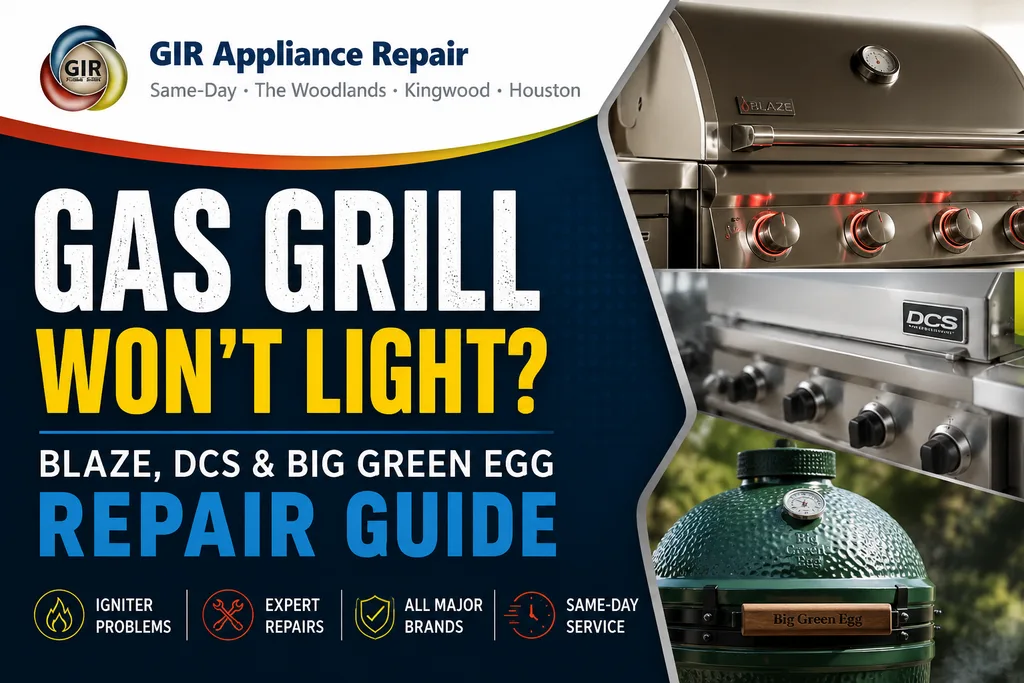
An outdoor grill that clicks but won’t light, or lights on some burners but not others, is a frustrating way to start a Houston-area cookout — and it’s one of the more overlooked repair categories GIR Appliance Repair handles, alongside indoor kitchen appliances. High-end built-in grills from brands like Blaze, DCS, Big Green Egg, Lynx, and Fire Magic use the same basic ignition components as any gas appliance, and most no-light or uneven-light problems trace back to a small handful of causes. This guide covers what typically stops a grill from lighting, how to tell the causes apart, and realistic repair costs.
Grill Ignition Symptoms & Likely Causes
| Symptom | Likely Cause | Est. Repair Cost |
|---|---|---|
| Igniter clicks but no spark | Dead or low battery, or a cracked ceramic electrode | $0–$90 (often DIY) |
| Spark present but burner won’t ignite | Clogged burner ports, often from spiders/insects nesting over winter | $0–$140 |
| One burner lights, others don’t | Individual burner valve or igniter wire failure | $100–$240 |
| Weak, low flame across all burners | Low propane, or a tripped regulator safety bypass | $0–$150 |
| Flame present but yellow/orange, not blue | Burner ports clogged or air mixture misadjusted | $90–$200 |
Igniter Clicks But No Spark
Most built-in grills use either a battery-powered piezo or electronic igniter with a small ceramic electrode near each burner. When the igniter clicks audibly but nothing sparks, a dead or corroded battery is the most common and cheapest cause to rule out first — grill igniter batteries are often overlooked since the grill isn’t used daily. If a fresh battery doesn’t solve it, the ceramic electrode itself may be cracked (a common failure point since it’s fragile and exposed to heat cycling), or the wire connecting the igniter module to the electrode has corroded from outdoor humidity, both of which require replacement parts.
Spark Works But the Burner Won’t Catch
If you can see or hear the spark firing but no flame follows, the problem has shifted from the ignition system to the gas delivery itself. The most common cause GIR technicians find on grills that haven’t been used in a while — especially after a Houston winter or a rainy stretch — is a spider or insect nest inside the burner tube, which is common enough on gas grills that manufacturers include warnings about it in their manuals. The nest blocks the small ports along the burner where gas is supposed to escape and ignite. A clogged burner is a straightforward DIY fix with a stiff wire brush or dedicated burner-port cleaning tool, but if it recurs repeatedly it’s worth having a technician install proper insect screens on the gas orifices.
One Burner Works, Others Don’t
On multi-burner grills, each burner typically has its own valve and, on electronic-ignition models, its own dedicated spark wire. When only one burner fails to light while the others work fine, the shared components (tank, regulator, main gas line) are working correctly, and the problem is isolated to that burner’s valve or igniter wire specifically. This is a more targeted repair than a whole-grill ignition problem and usually just involves replacing the single failed valve or wire rather than anything upstream.
Regulator Safety Bypass: Why All Burners Suddenly Run Low
Propane regulators include a safety feature that restricts gas flow to a trickle if it detects a sudden pressure drop, like what happens if a gas valve is opened too quickly with the tank valve already fully open. This shows up as every burner producing a weak, low flame across the board, even with a full tank. The fix doesn’t require any parts — turn off all burner knobs and the tank valve, wait a minute, then open the tank valve slowly (about halfway) before turning on burners one at a time. This resets the bypass and restores normal flow in the majority of cases.
DIY vs. Calling a Professional
Battery replacement, burner port cleaning, and the regulator reset above are all safe, straightforward DIY fixes that resolve a large share of grill no-light complaints. Where it’s worth calling a technician is anything involving gas line connections, valve replacement, or a persistent gas smell — and if you ever smell gas that doesn’t clear after turning everything off and waiting, don’t attempt to relight the grill; shut off the tank and have it inspected before using it again.
Built-In vs. Freestanding Grills
Built-in outdoor kitchen grills from brands like Blaze, DCS, Lynx, and Fire Magic are typically plumbed to a natural gas line rather than running off a portable propane tank, which removes the low-tank and regulator-bypass issues common to propane grills but introduces its own consideration: natural gas burners are sized and rated differently than propane burners, and a valve or orifice replaced with the wrong part for the fuel type will produce a weak, inefficient flame even though everything appears to be working. This is one of the more common mistakes in DIY grill part replacement — ordering a generic propane replacement part for what is actually a natural-gas-plumbed built-in unit.
Seasonal Maintenance for Houston’s Climate
Grills that sit unused for stretches during Houston’s hot summer months or through a mild winter are especially prone to the insect-nest burner clogging described above, since burner tubes make an appealing, sheltered nesting spot when not heating up regularly. A quick inspection and light cleaning of burner ports at the start of each grilling season — even on a grill that seemed fine the last time it was used — catches this before it turns into a no-light service call. It’s also worth checking propane tank connections and hoses for cracking from UV exposure, which is more of a factor in Texas’s intense summer sun than in milder climates.
Rotisserie Burners & Side Burners: Separate Systems
Many built-in grill setups include a rear-mounted rotisserie burner and one or more side burners as separate systems from the main cooking burners, each with its own gas line, valve, and often its own igniter. If a main burner works fine but a side burner or rotisserie won’t light, that’s a strong signal the problem is isolated to that specific accessory’s valve or igniter wire rather than anything shared with the main grill, and diagnosis follows the same one-burner-out troubleshooting described above, just applied to the accessory burner instead.
Propane vs. Natural Gas Conversion Issues
Some grills are convertible between propane and natural gas with a conversion kit that swaps out burner orifices for the correct size, since the two fuel types burn at different pressures and require differently sized openings. A grill that was recently converted, or one that was purchased used without confirming which fuel type it’s set up for, can produce weak or uneven flames if the orifices don’t match the gas source actually connected — a detail that’s easy to overlook but straightforward for a technician to verify and correct.
What GIR Checks During a Grill Repair Visit
A typical grill service call starts with a visual and functional check of every burner individually, testing spark presence at each igniter, inspecting burner tubes for insect blockage or corrosion, and checking gas pressure at the regulator. Because grills sit outdoors and face more environmental exposure than any indoor kitchen appliance, technicians also check hose and fitting condition for UV or weather-related wear as part of a thorough visit, not just the specific symptom that prompted the call.
🔧 Need a professional repair?
GIR Appliance Repair serves Houston, The Woodlands & Kingwood — same-day availability.
Storing Your Grill Between Uses
A quality grill cover reduces the exposure that leads to both insect nesting and hose/fitting weathering, and running the grill on high heat with the lid closed for 10–15 minutes after each use burns off residual grease that would otherwise attract pests and cause flare-ups on the next use. These two habits together prevent a meaningful share of the ignition and burner problems covered in this guide before they start.
Frequently Asked Questions
Why does my grill igniter click but not spark?
Check the battery first — it’s the most common and cheapest cause. If a fresh battery doesn’t fix it, the ceramic electrode or igniter wire has likely failed and needs replacement.
Why won’t my grill light even though I hear a spark?
This usually means the burner ports are clogged, often from an insect nest built up inside the burner tube during periods the grill wasn’t used. Clean the ports with a wire brush or burner cleaning tool.
Why is only one burner not lighting on my grill?
Each burner typically has its own valve and igniter wire. A single non-working burner while others work fine usually means that burner’s specific valve or wire has failed, not a whole-grill issue.
Why do all my burners suddenly have weak flames?
This is often a propane regulator safety bypass triggered by opening the gas too quickly. Turn everything off, wait a minute, then reopen the tank valve slowly before relighting.
Do you repair Blaze, DCS, and Big Green Egg grills?
Yes, GIR services Blaze, DCS, Big Green Egg, Lynx, Fire Magic, Weber, Napoleon, and most other built-in and freestanding grill brands across Houston, The Woodlands, Kingwood, Spring, and Conroe. Call (346) 625-4289 to schedule.
Grill won’t light or burning unevenly before your next cookout? Contact GIR online or call (346) 625-4289 for same-day diagnosis across Houston, The Woodlands, Kingwood, Spring, and Conroe.
Ready to schedule your repair?
We serve The Woodlands, Kingwood, Spring, Humble & greater Houston. Call or book online.