
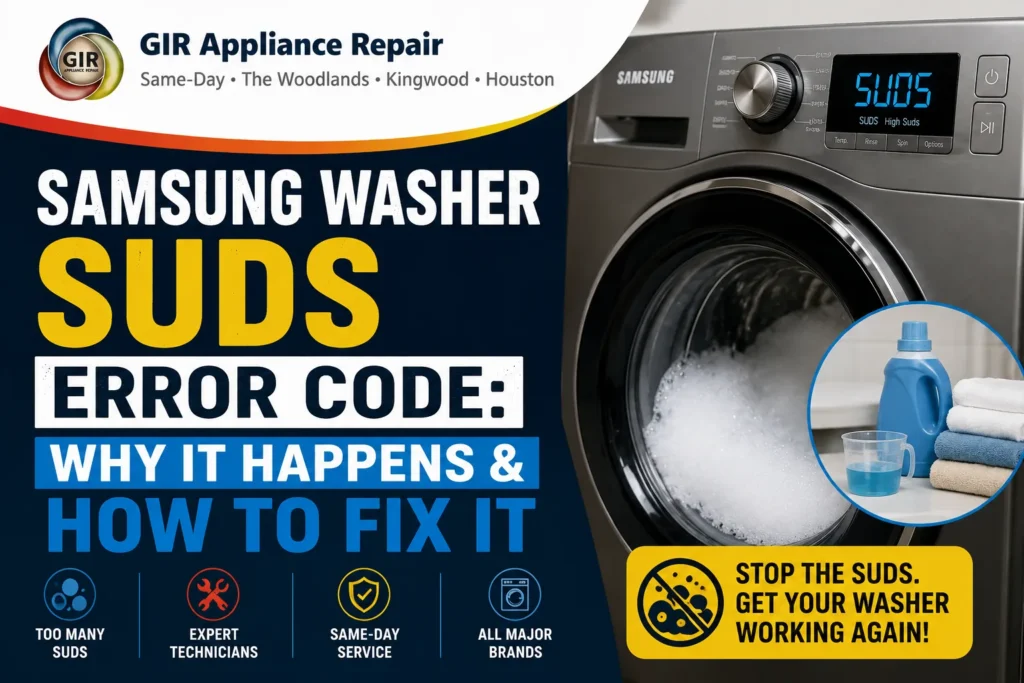
If your Samsung front-load washer’s display suddenly shows SUdS (sometimes written as SUD, 8C1, 8C2, or 8C depending on the model), the machine isn’t broken — it’s actively working to fix a problem it detected on its own. This is one of the most-searched Samsung washer codes because it’s also one of the most misunderstood: most homeowners assume it means a leak or a serious malfunction, when it almost always means too much detergent. GIR Appliance Repair explains what’s really happening, why it keeps coming back, and the rare cases when it does need a technician.
What Does the SUDS/8C Error Actually Mean?
Unlike most washer error codes, SUDS isn’t a failure code — it’s Samsung’s built-in oversudsing detection kicking in. When the machine’s sensors detect more foam than the wash cycle is designed to handle, it automatically pauses the normal cycle and runs extra rinse steps to clear the excess suds before continuing. “SUdS” or “SUD” displays while this is happening, and the machine shows “End” once the extra rinsing has cleared the foam and the cycle can finish normally. Samsung’s own service documentation for this washer family is explicit that this is one of the normal operations built into the machine specifically to prevent a non-sensing fault — in other words, it’s a safeguard, not a defect.
Why Samsung Washers Are More Sensitive to Suds Than Older Machines
High-efficiency (HE) front-load washers like Samsung’s use dramatically less water per cycle than older top-load machines — often a third as much. Regular, non-HE detergent is formulated to produce heavy suds because older machines had plenty of water and agitation to rinse them out. In an HE front-loader, that same amount of detergent simply doesn’t have enough water to rinse away, and the excess foam can interfere with the drum’s ability to sense water level and load balance accurately — which is exactly what the SUDS detection is designed to catch before it causes a bigger problem.
Common Causes of a SUDS/8C Error
| Cause | How Common | Fix |
|---|---|---|
| Using non-HE (regular) detergent | Very common | Switch to HE-rated detergent (free) |
| Using too much detergent, even if HE-rated | Very common | Reduce dose per load (free) |
| Detergent drawer connector hose out of place | Occasional | $100–$180 |
| Detergent residue buildup inside drum/gasket | Common on older units | $0 (drum-clean cycle) or service visit |
| Foam/leak sensor (Mems PBA) fault | Rare | $180–$320 |
The #1 Fix: Detergent Type and Amount
If you’re seeing SUDS regularly, check the detergent bottle for the “HE” symbol first — this single change resolves the large majority of recurring SUDS errors GIR technicians see on Samsung washers. If you’re already using HE detergent, the next most common cause is simply using too much of it. Modern HE detergent is concentrated, and the pre-measured cap most bottles include is often more than a Samsung front-loader’s smaller water volume actually needs for an average load. Try reducing your usual dose by roughly a third and see whether the error stops recurring over your next several loads.
Detergent Drawer Connection
Samsung’s service documentation notes that the SUDS/8C error can also be triggered by a water leakage condition around the detergent drawer specifically — if the hose connecting the drawer to the tub is out of place, seated incorrectly, or the drawer itself isn’t fully engaged, water and foam can behave unpredictably enough to trip the sensor even with a normal detergent amount. This is a quick check-and-reseat repair for a technician if the detergent-and-dosage fixes above don’t resolve it.
Residue Buildup From Past Overdosing
If your washer has been run with too much or non-HE detergent for a while before you noticed the SUDS errors, residue can build up inside the drum, door gasket, and internal hoses in a way that keeps triggering foam-related errors even after you switch detergents. Running an empty hot-water cycle with a washer-cleaning tablet or a cup of white vinegar (check your owner’s manual first) can clear out mild buildup. If SUDS errors continue after a proper cleaning cycle and correct detergent use, it’s worth having a technician inspect for buildup in less accessible areas.
When It’s Actually a Sensor Fault
In a smaller number of cases, the SUDS code recurs even with correct, HE-only detergent used sparingly and a clean drum — this points toward the Mems PBA (the sensor board that monitors for both foam and leaks) reporting a fault rather than genuinely detecting excess suds. This is uncommon compared to the detergent-related causes above, but it does happen, especially on washers that have had a prior water leak or high-humidity exposure. A technician can check the sensor’s wire connections first, since a loose or corroded connector is a more affordable fix than replacing the board itself.
The Houston Connection: Suds Residue and Odor
There’s a link between recurring SUDS errors and a musty washer smell that GIR technicians see often in the Houston area’s humid climate. Detergent residue left behind from repeated oversudsing doesn’t fully rinse or dry out between loads, and Houston’s higher ambient humidity slows drying in the drum and door gasket compared to drier climates — giving mold and mildew more time to take hold in that residue. If you’ve noticed both a recurring SUDS error and an odor developing, addressing the detergent amount and running a cleaning cycle typically resolves both issues at once, since they usually share the same root cause. See our guide on eliminating washing machine odors for the full cleaning routine.
Is It Safe to Keep Using the Washer?
Yes — a SUDS error resolving on its own into “End” is the washer working exactly as designed. There’s nothing to repair if this only happens occasionally after a heavier-than-usual detergent dose. It’s worth addressing only if it happens on nearly every load despite using the correct HE detergent amount, since that pattern suggests either a connection or sensor issue rather than normal user variance.
DIY Checks Before You Call
- Confirm your detergent is HE-rated (look for the “he” symbol on the bottle).
- Cut your usual detergent dose by about a third and monitor the next few loads.
- Run an empty hot-water cycle with a washer-cleaning tablet to clear existing residue.
- Check that the detergent drawer is fully closed and seated after adding detergent.
- If the error clears to “End” on its own, no repair is needed — just adjust detergent going forward.
Models This Applies To
This guide reflects Samsung’s official service documentation for the WF45M5500AP, WF45M5500AZ, WF45M5500AW, WF45M5100AW, WF45N5300AV, WF45N5300AF, and WF45N5300AW front-load washer family, though the SUDS detection logic is common across most modern Samsung front-loaders. Use our Samsung Appliance Age Lookup tool if you’re not sure which model you have.
🔧 Need a professional repair?
GIR Appliance Repair serves Houston, The Woodlands & Kingwood — same-day availability.
Frequently Asked Questions
Does a SUDS error mean my Samsung washer is broken?
No — in the vast majority of cases it means too much detergent (or non-HE detergent) was used, and the washer is running extra rinse cycles automatically to clear it. It usually resolves to “End” on its own.
Why does my Samsung washer keep showing SUDS even with a small amount of detergent?
If you’re already using a small, correctly-dosed amount of HE detergent and still seeing it regularly, check for detergent residue buildup in the drum and drawer hose first, and have a technician check the drawer connection or foam sensor if a cleaning cycle doesn’t resolve it.
How much does it cost to fix a recurring SUDS error?
If it’s a detergent issue, nothing — just adjust type and amount. A drawer hose or connector fix typically runs $100–$180; a sensor board issue is less common and runs higher, around $180–$320. GIR always diagnoses before quoting a repair.
Should I stop the cycle when SUDS appears?
No, let it run — interrupting the cycle while the washer is actively clearing excess foam can leave the load partially rinsed. Let it reach “End” on its own.
Does GIR repair Samsung washers in the Houston area?
Yes — GIR Appliance Repair services Samsung washers and all major brands across Houston, The Woodlands, Kingwood, Spring, and Conroe. Call (346) 625-4289 for same-day diagnosis.
Samsung washer stuck on SUDS or repeating the error every load? Contact GIR online or call (346) 625-4289 for same-day service across Houston, The Woodlands, Kingwood, Spring, and Conroe.
Ready to schedule your repair?
We serve The Woodlands, Kingwood, Spring, Humble & greater Houston. Call or book online.