
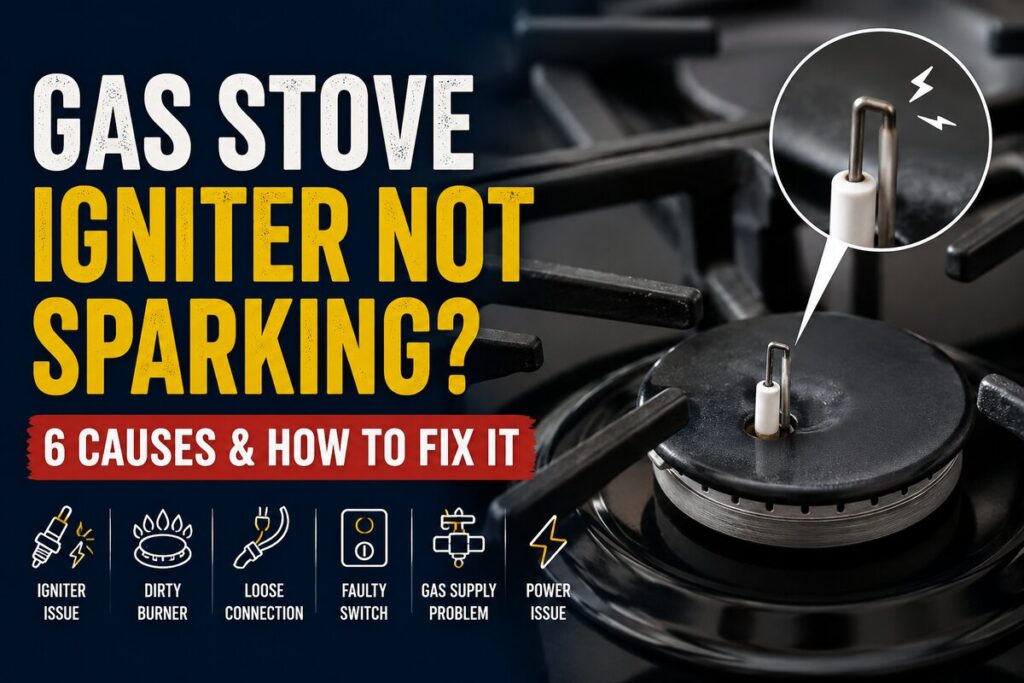
You turn the knob on your gas stove, hear the click-click-click of the igniter, but no spark appears and the burner won’t light. Or maybe the spark is weak and inconsistent, only igniting after several attempts. Gas stove igniter failure is one of the most common appliance problems we see at GIR, and the good news is that most cases have a straightforward cause and fix.
In this guide we’ll walk through the six most common reasons a gas stove igniter stops sparking — and what you can do about each one. We’ll also cover the difference between a single-burner problem and an all-burner failure, important safety considerations, and when to call a professional repair technician in The Woodlands or Spring, TX.
How a Gas Stove Igniter Works
The igniter on a gas stove is an electric spark ignition system. When you turn a burner knob to the ignite position (or push it in on some models), a spark module sends an electrical pulse to a ceramic electrode at each burner. That electrode generates a spark — the clicking sound you hear — which ignites the gas as it flows from the burner valve.
The system has four main components: the igniter switch (controlled by the knob), the spark module (a circuit board that distributes ignition signals), the spark wire (connects module to each electrode), and the igniter electrode itself (the ceramic tip at the burner). Any one of these can fail and cause a no-spark condition.
Cause 1: Food Debris Clogging the Igniter
This is the single most common reason a gas stove igniter stops sparking. Over time, grease, food residue, and boilover spills coat the igniter electrode. The ceramic tip needs a clean surface to generate a strong spark — when it’s coated in debris, the spark either can’t form or dissipates before it reaches the gas.
How to fix it:
- Turn off the burner and wait for the stove to cool completely.
- Remove the burner cap and burner head (they lift off on most models).
- Use a soft-bristle toothbrush and a small amount of dish soap to gently scrub the igniter electrode and the area around it.
- For stubborn deposits, use a wooden toothpick to clear debris from the electrode tip — avoid metal tools that can crack the ceramic.
- Let everything dry completely before reassembling. Moisture on a ceramic igniter can prevent sparking.
- Reassemble the burner parts, making sure the burner cap is properly seated and aligned.
In many cases, a thorough cleaning restores normal ignition immediately. If the igniter still doesn’t spark after cleaning, move on to the next causes.
Cause 2: Wet or Moisture-Damaged Igniter
If you’ve recently cleaned your stove — especially if water or cleaning solution got into the burner area — moisture on the igniter electrode is a likely culprit. A wet igniter may actually spark, but you’ll hear rapid clicking with no ignition, or the spark may be visible but too weak to ignite gas.
How to fix it:
- Remove the burner cap and burner head to expose the igniter electrode area.
- Dry the area with a clean cloth, then allow it to air dry for at least 30 to 60 minutes.
- For faster drying, you can use a hair dryer on a low heat setting held several inches away — do not use high heat.
- Alternatively, a brief burst of canned air can clear moisture from tight spaces around the electrode.
- Reassemble and test.
A wet igniter is often a temporary condition. If moisture was the only issue, the igniter should work normally once fully dried. If drying doesn’t resolve the problem, the moisture may have caused a failure in the igniter switch or spark module.
Cause 3: Defective Igniter Switch
Each burner on your gas stove has its own igniter switch, which is activated when you rotate the corresponding knob. The switch sends a signal to the spark module to generate a spark at that specific burner. When the switch fails, the module never receives the signal, and that burner’s igniter won’t spark — even if everything else in the system is working.
Signs of a bad igniter switch:
- One specific burner won’t spark even after cleaning and drying
- The igniter at that burner doesn’t click at all when the knob is turned
- Other burners on the same stove spark normally
Testing and replacement: Igniter switch testing requires a multimeter to check for continuity. If the switch shows no continuity when activated, it needs replacement. This is a component-level repair — the switch is typically accessed from inside the stove control panel. While it’s technically a DIY repair for someone comfortable with appliance disassembly, we recommend having a professional handle it to avoid damaging the control panel harness.
Cause 4: Faulty Spark Module
The spark module is the central circuit board that controls ignition across all burners. When you activate any burner’s igniter switch, that signal routes through the spark module, which then sends the spark pulse to the appropriate electrode. When the spark module fails, it typically affects multiple burners simultaneously.
Signs of a bad spark module:
- Multiple burners (or all burners) stop sparking at the same time
- The module may continue clicking on its own when no knob is turned (a sure sign of failure)
- Visible burn marks or a burnt smell near the module location
The spark module is usually located behind the control panel or beneath the cooktop. It’s a straightforward replacement once the correct model-specific module is sourced, but accessing it requires stove disassembly. This is a job for a professional technician in most cases. See our oven and range repair page for more information on what we service.
Cause 5: Damaged Spark Wire or Loose Connection
Each igniter electrode is connected to the spark module by a spark wire — a heat-resistant wire with a ceramic insulator. These wires run through the stove interior and can be damaged by heat exposure, physical contact with sharp edges during cleaning, or simply loosening from their connectors over time.
Signs of a wire problem:
- Intermittent sparking at one burner — works sometimes, not others
- A single burner stops working despite a clean, dry electrode
- Visible signs of wire insulation melting or cracking on the stove interior
How to diagnose: With the stove unplugged, trace the spark wire from the affected electrode back to the spark module. Look for breaks, kinks, or disconnected terminals. Re-seating a loose connector is a simple fix. A damaged wire segment needs to be replaced. Wire replacement is a moderate DIY repair, but routing wires correctly through the stove interior without pinching them requires care.
Cause 6: Worn-Out Igniter Electrode
The igniter electrode itself — the ceramic-tipped component that generates the actual spark — does wear out over time. The ceramic can develop hairline cracks from thermal cycling (heating and cooling repeatedly), and the metal tip can erode. A cracked or eroded electrode may produce a weak or inconsistent spark, or no spark at all.
Signs of a worn electrode:
🔧 Need a professional repair?
GIR Appliance Repair serves Houston, The Woodlands & Kingwood — same-day availability.
- Visible cracks in the ceramic body of the igniter
- Black carbon buildup that cannot be cleaned off
- Electrode tip visibly eroded or pitted
- Weak, inconsistent sparking even with a clean electrode
Electrode replacement is one of the more straightforward igniter repairs. The electrode is typically secured with one or two screws and has a single wire connection. However, the correct replacement part must match your stove’s brand and model number exactly — a wrong-fit electrode can be too short to properly spark the burner.
One Burner vs. All Burners Not Sparking: Different Diagnosis Paths
The number of affected burners gives you an important diagnostic clue:
- One burner won’t spark: The problem is almost certainly isolated to that burner’s components — food debris, a wet electrode, a bad igniter switch, a damaged spark wire, or a worn electrode. The spark module is almost certainly fine.
- All burners won’t spark simultaneously: The problem is almost certainly the spark module or the stove’s power supply. Check that the stove is plugged in and the circuit breaker is not tripped. If power is confirmed, the spark module is the likely failure.
- Burners randomly stop sparking or spark without a knob being turned: This points to a spark module that is failing intermittently or has stuck relay contacts.
This distinction saves significant diagnostic time. A technician who immediately assumes all-burner failure is a spark module issue — or assumes a single-burner issue requires a full module replacement — is likely missing the actual problem.
Safety Warning: When NOT to DIY
Before attempting any gas stove igniter repair, understand one critical safety rule: if you smell gas at any point, stop immediately.
- Do not attempt to ignite the burner manually.
- Do not try to diagnose or repair any component.
- Turn off the gas supply to the stove at the shutoff valve (usually behind the stove or under the counter).
- Ventilate the area by opening windows and doors.
- Leave the home and call your gas utility company’s emergency line.
Gas odor near a stove indicates a gas leak — a dangerous condition that is completely separate from an igniter problem. Never attempt to fix a gas leak yourself. Only resume use of the stove after a qualified gas technician has inspected and cleared the appliance.
Additionally, if you are not comfortable working around electrical components or disassembling appliances, call a professional. Gas stove igniter repairs are generally safe for DIYers with the right knowledge, but electrical mishandling can damage the stove’s control electronics or create a shock hazard.
Cost to Repair a Gas Stove Igniter
| Repair Type | DIY Cost | Professional Cost |
|---|---|---|
| Cleaning (debris or moisture) | $0 (supplies on hand) | $75–$130 (service call + labor) |
| Igniter electrode replacement | $15–$40 (part only) | $130–$250 |
| Igniter switch replacement | $20–$50 (part only) | $150–$280 |
| Spark module replacement | $30–$80 (part only) | $180–$350 |
| Spark wire replacement | $10–$30 (part only) | $130–$220 |
Professional costs include GIR’s $75 service call fee (applied toward the repair) plus parts and labor. On most gas stove igniter repairs, you’ll pay between $130 and $350 total for a professional repair — significantly less than the cost of a new range.
How GIR Diagnoses Gas Stove Ignition Problems in The Woodlands and Spring, TX
When you call GIR for a gas stove igniter problem, our technician follows a systematic diagnosis process rather than guessing. We start by determining whether one burner or multiple burners are affected — this immediately narrows the likely cause. We then inspect the electrode for debris and damage, test the igniter switch for proper operation, check the spark wire for continuity and physical damage, and test the spark module output.
This approach means we identify the actual failed component rather than replacing parts speculatively. Most gas stove igniter problems in The Woodlands and Spring homes are resolved in a single visit. We service all brands including Wolf, GE, Samsung, LG, Bosch, Whirlpool, KitchenAid, and Frigidaire. For premium range brands, see our dedicated Wolf appliance repair and Thermador appliance repair pages.
Call us at (346) 625-4289 to schedule same-day service for your gas stove igniter problem. We cover The Woodlands, Spring, Kingwood, Humble, Conroe, and surrounding areas.
Frequently Asked Questions
Is it safe to use my stove if the igniter on one burner isn’t working?
If you do not smell gas and the other burners work normally, you can use the working burners while waiting for a repair. However, do not try to light the non-functioning burner manually with a match or lighter — this can lead to a gas buildup that ignites suddenly. The safest approach is to stop using the affected burner until it’s repaired.
Why does my gas stove keep clicking even when the burner is lit?
Continuous clicking after a burner is lit is almost always caused by moisture or food debris on the igniter electrode. It can also be caused by a misaligned burner cap. Clean the electrode area and burner cap, make sure the burner cap is properly seated, and allow everything to dry. If clicking continues, the spark module may have a stuck relay — a professional diagnostic is recommended.
Can I replace a gas stove igniter myself?
Many homeowners successfully replace igniter electrodes and spark modules themselves using parts ordered online. The key requirements are sourcing the exact part number for your stove model, being comfortable with basic appliance disassembly, and working with the stove unplugged. If you’re unsure, a professional repair is the safer and often faster option.
My stove is a Samsung / LG / Bosch — does GIR service those brands?
Yes. GIR services all major gas range brands in The Woodlands and Spring areas. We carry parts for Samsung, LG, GE, Whirlpool, Frigidaire, Bosch, KitchenAid, Maytag, and many others. Call us with your model number and we can confirm whether we have your part on the truck.
How long does a gas stove igniter repair take?
In most cases, 30 to 90 minutes depending on the cause. A cleaning or electrode replacement is quick. A spark module replacement requires more disassembly but is still usually completed in one visit. If your specific part needs to be ordered, we’ll schedule a return visit once it arrives.
My igniter sparks but the burner still won’t light — what’s wrong?
If the igniter is sparking but the burner won’t light, the gas supply to that burner is the likely issue rather than the igniter. Possible causes include a clogged burner port (the small holes around the burner head through which gas flows), a problem with the gas valve, or a misaligned burner cap that prevents gas and spark from meeting properly. Check that the burner cap and burner head are properly seated, then clear any clogged ports with a needle or pin. If the issue persists, call a professional — a gas valve problem requires a technician to diagnose safely.
Oven taking much longer than it used to for preheat? See our guide to oven thermostat and sensor symptoms. And if it’s your outdoor grill giving you ignition trouble instead, see our grill won’t light repair guide.
Ready to schedule your repair?
We serve The Woodlands, Kingwood, Spring, Humble & greater Houston. Call or book online.