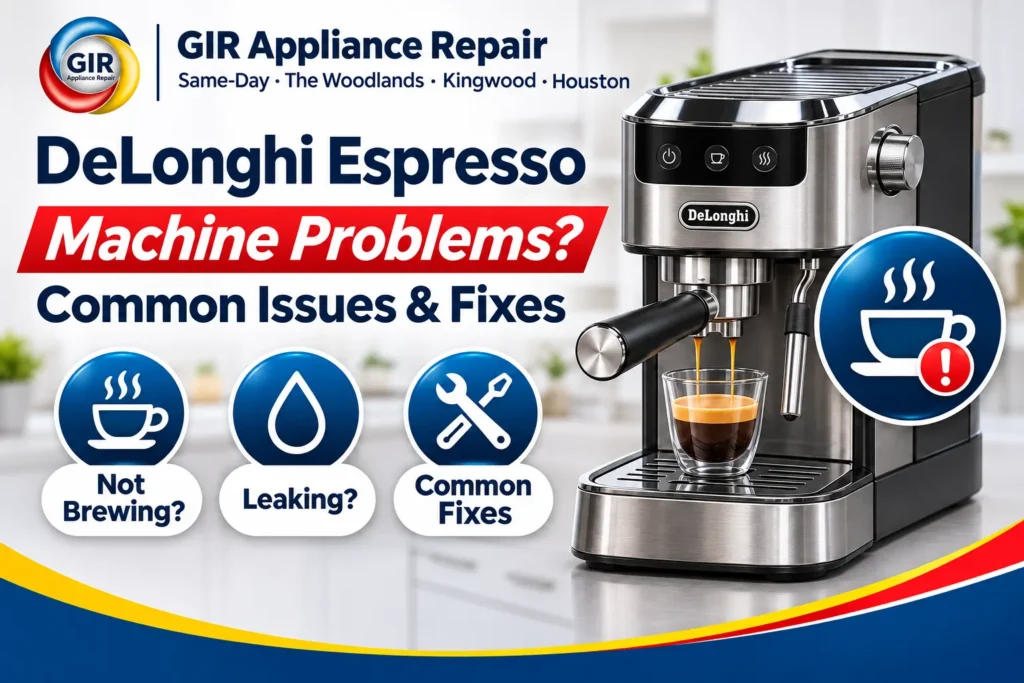
A De’Longhi espresso machine that suddenly pours weak, lukewarm coffee, flashes a red warning light, or grinds beans but delivers nothing into the cup is one of the most frustrating breakdowns in the kitchen — mostly because it happens before your first coffee of the day. We service De’Longhi super-automatic machines (Magnifica, Magnifica Evo, Dinamica, Eletta, PrimaDonna and Rivelia) as well as the semi-automatic Dedica and La Specialista models across Houston, The Woodlands, Spring, Kingwood and Conroe, and the same handful of problems account for the vast majority of the calls we get. This guide explains what each symptom usually means, what you can safely check yourself in a few minutes, what a repair typically costs, and when a machine is worth fixing.
One thing to know up front: De’Longhi warning lights and display messages differ between model lines, so the exact light pattern on a Magnifica S is not the same as on a Dinamica Plus. Use the symptom table below as a map, and confirm the specific message in your model’s manual or on De’Longhi’s support site.
De’Longhi Espresso Machine Problems: Symptoms & Likely Causes
| What you notice | Most likely cause | Est. Repair Cost |
|---|---|---|
| Weak, watery or sour coffee | Grind too coarse, worn burrs, clogged brew unit, scale in the boiler | $0–$220 |
| Coffee not hot enough | Scale on the thermoblock, temperature set too low, failing heating element or sensor | $0–$380 |
| Grinder runs, no coffee comes out | Blocked spouts or brew unit, scale in the water circuit, failing pump | $0–$320 |
| Descale light stays on after descaling | Cycle interrupted or not registered, wrong water hardness setting | $0–$150 |
| Red or general alarm light | Brew unit not seated, drip tray or grounds container missing, internal fault | $0–$300 |
| Water under the machine | Overfilled drip tray, cracked tank, worn brew unit seal or internal hose | $90–$280 |
| Steam wand won’t froth milk | Dried milk in the wand or frother, scale, steam valve problem | $0–$220 |
| Loud grinding or clicking, beans not ground | Stone or foreign object in the grinder, oily beans clogging the burrs, worn grinder gear | $150–$300 |
Cost ranges are typical for the Houston area and include parts and labor; the exact price is confirmed after diagnosis. Our $75 service call is applied toward the repair.
1. Weak, Watery or Sour Coffee
This is the single most common De’Longhi complaint, and the good news is that it is often an adjustment rather than a broken part. Super-automatic machines grind, dose and brew in one sequence, so anything that lets water rush through the coffee too fast produces a thin, under-extracted cup.
What to check yourself
- Grind setting. Turn the grinder dial one or two steps finer while the grinder is running (adjusting it while stopped can damage the burrs on many models), then brew two or three cups before judging the result.
- Coffee strength / aroma setting. If it was bumped to the mildest setting, the machine doses less coffee per cup.
- Brew unit. Remove it (on most models it slides out from the side door), rinse it under lukewarm water with no soap, let it dry and refit it. A brew unit packed with old grounds compresses unevenly.
- Beans. Very dark, oily beans gum up the grinder chute over time and starve the brew chamber. Medium roasts are kinder to super-automatic grinders.
When it’s a repair
If adjusting the grind changes nothing, the burrs may be worn or the grinder chute blocked, or the brew unit’s seals and piston are no longer holding pressure. Scale buildup inside the water circuit can also reduce flow and temperature at the same time. These jobs typically run $120–$220. For a deeper look at pressure-related problems, see our guide to coffee machines losing pressure during brewing.
2. Coffee Not Hot Enough
De’Longhi machines heat water on demand in a thermoblock rather than holding a large boiler at temperature. Scale insulates the thermoblock walls, so the machine has to work harder and still delivers cooler coffee. In the Houston area, with its moderately hard to hard municipal water, this is the number one cause of lukewarm espresso we find.
- Check the coffee temperature setting in the menu and set it to high.
- Pre-warm your cup — a cold ceramic cup can drop espresso temperature noticeably.
- Run a full descaling cycle with De’Longhi descaler if the descale reminder has been on or ignored.
If the coffee is still cool after descaling, the heating element, temperature sensor (NTC) or a thermal fuse may be failing. Thermoblock and sensor repairs typically cost $200–$380 depending on the model.
3. Grinder Runs but No Coffee Comes Out
You hear the grinder, the brew unit moves, and then only a few drops — or nothing — reach the cup. Start with the simple blockages:
- Clean the coffee spouts and the dispenser; dried coffee oils can block them completely.
- Empty the grounds container and the drip tray, then restart the machine.
- Remove and rinse the brew unit, checking that nothing is jammed in the brew chamber.
- Run hot water only. If hot water flows normally but coffee does not, the problem is in the brew path; if hot water also fails, suspect scale or the pump.
A pump that hums loudly without moving water, or a machine that stopped working right after an interrupted descale, usually needs a technician. Pump replacement typically runs $180–$320.
4. Descale Light Won’t Go Off
A flashing descale symbol generally means descaling will be due soon; a steady one means it should be done now. If the light stays on even though you just descaled, the most common reasons are an interrupted cycle (the tank ran dry or the machine was switched off mid-cycle) or a descale started from the wrong menu so the machine never registered it. Run the full cycle again from the beginning without interruption, including the rinse phase, and set the water hardness in the menu so the reminder timing matches your water. If the counter still won’t reset, the control board or flowmeter may need attention.
5. Red or General Alarm Light
Before assuming the worst, work through the “missing part” alarms, which trigger most red lights:
- Is the brew unit fully seated and the service door closed?
- Are the drip tray and grounds container pushed fully home? Moving the tray even a few millimetres can trigger a warning.
- Is the water tank seated and above the minimum line?
- Is the bean hopper empty, or is the pre-ground coffee funnel blocked?
If an alarm persists after all of these are fine, or the machine shows a general alarm and refuses to start, unplug it for a few minutes, restart, and if it returns, book a diagnosis. A persistent general alarm can point to a sensor, motor or control board fault.
🔧 Need a professional repair?
GIR Appliance Repair serves Houston, The Woodlands & Kingwood — same-day availability.
6. Leaks Under the Machine
Most “leaks” are a drip tray that filled faster than expected — the machine rinses itself on startup and shutdown, and that water goes into the tray. A real leak shows up as water on the counter with the tray empty. Common causes are a hairline crack in the water tank, a worn brew unit gasket, or a loose or cracked internal hose. Unplug the machine and stop using it if water is coming from inside the housing, since it sits close to electrical parts.
7. Milk Frother or Steam Wand Problems
Milk dries fast and blocks the tiny air intake that creates froth. Clean the frother or LatteCrema carafe after every use, soak the parts in warm water, and clear the air hole with a pin. If steam is weak even with a clean wand, scale is the usual cause; if no steam comes out at all after descaling, the steam valve or thermoblock may need service.
Houston-Area Water and Your Espresso Machine
Hard water is the quiet reason many De’Longhi machines in our area fail early. Scale forms inside the thermoblock, pump and valves long before you see any white crust on the outside. Three habits make a big difference:
- Set the water hardness in the menu (the test strip that came with the machine takes a minute).
- Use the De’Longhi water filter in the tank if your model supports it, and replace it on schedule.
- Descale when the machine asks, not when it stops working.
DIY Maintenance Checklist
| Task | How often |
|---|---|
| Empty and rinse drip tray and grounds container | Daily |
| Clean milk frother or carafe | After every use |
| Rinse the brew unit (no soap) | Weekly |
| Clean coffee spouts and brew chamber | Monthly |
| Descale with De’Longhi descaler | When prompted (every 1–3 months with hard water) |
| Replace the water filter | Every 2 months or as prompted |
Repair or Replace Your De’Longhi?
A super-automatic De’Longhi typically costs $700–$2,500 new, which makes most repairs worth doing. As a rule of thumb, repair the machine if it is under eight years old and the repair costs less than about half the price of a comparable new model. Grinder, brew unit, pump and thermoblock repairs usually extend a well-maintained machine’s life by several years. Replacement makes more sense when the control board has failed on an older entry-level model, or when several major parts are worn at the same time. Not sure how old your machine or any other appliance is? Our free appliance age lookup reads the build date from the serial number.
Frequently Asked Questions
Why is my De’Longhi coffee suddenly weak?
Usually the grind is too coarse, the coffee strength setting was lowered, or the brew unit needs rinsing. Adjust the grinder one step finer while it is running and brew a few cups before judging. If nothing changes, the burrs or brew unit seals may be worn.
Can I use vinegar to descale a De’Longhi?
De’Longhi recommends its own descaler. Vinegar can be harsh on internal seals and is harder to rinse out completely, so it is not a good long-term substitute for these machines.
How much does De’Longhi espresso machine repair cost?
Most repairs in the Houston area run between $120 and $320, with heating and thermoblock repairs at the higher end. Simple fixes such as a seated brew unit or a cleared spout cost nothing beyond the service call if you need us to diagnose it.
Do you repair De’Longhi machines at home?
Yes. Many diagnostics and repairs are done on site; some major repairs on super-automatic machines are completed in our shop and the machine is returned to you.
Also on the GIR Blog
Need Help With a De’Longhi That Won’t Brew Right?
GIR Appliance Repair fixes De’Longhi, Jura, Gaggia, Saeco and Breville espresso machines across Houston, The Woodlands, Spring, Kingwood, Humble and Conroe, often the same or next day. See our De’Longhi repair page and coffee machine repair service, or call or text (346) 625-4289. The $75 service call is applied toward your repair.
Ready to schedule your repair?
We serve The Woodlands, Kingwood, Spring, Humble & greater Houston. Call or book online.